
How VOCs Are Tested in Well Water: Lab Method Explained
A VOC kit arrives with small glass vials, a preservative
Free Shipping on Orders of $100 or More
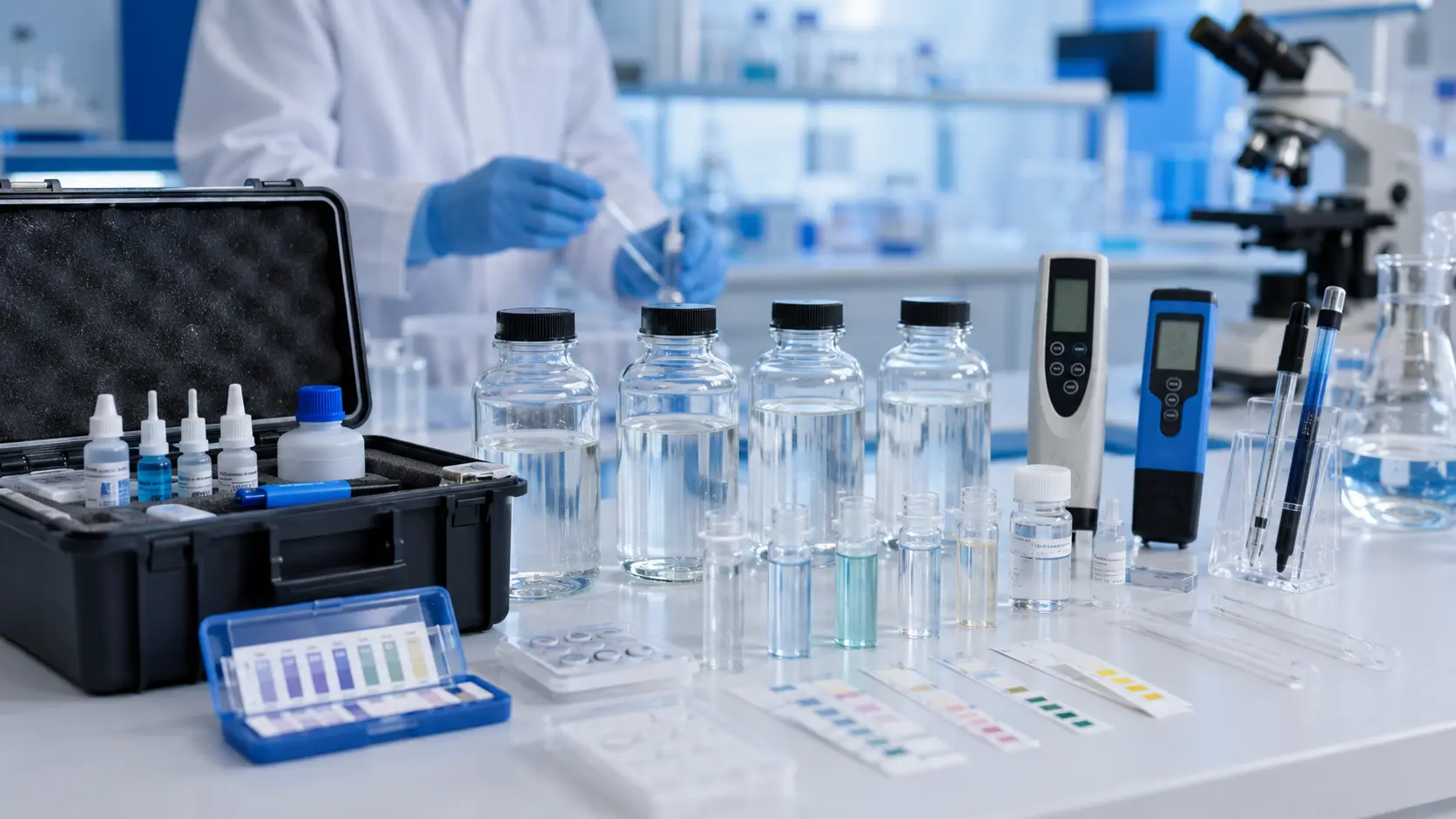
Search for a way to check your water, and four different products show up. A paper strip that changes color in a glass. A small meter with a digital screen. A box of bottles you fill and mail to a lab. A technician who drives out and collects the sample for you.
These four options are not just different prices for the same answer. Each one checks a different set of things, and each one gives you a different level of confidence. This guide sorts them out and points you toward the right pick, so you can buy once and stop shopping around.
The phrase covers four very different products. A strip you read by eye against a printed color chart. A small probe that gives you a number in seconds. A shipping box of bottles that a lab analyzes for you. Or a scheduled visit where a trained collector takes the sample and documents it.
The difference between them goes beyond accuracy alone. Each one produces a different kind of information. A strip tells you a property of the water changed. A lab report names a compound and states its exact amount. Those are two different answers to two different questions.
Each type below follows the same pattern: what it is, what it can see, what it tends to cost, and who it suits best. Read through all four before you decide, because the cheapest option that answers your real question is the right buy.
Water test strips are treated paper pads on a plastic handle. You dip the strip, wait a few seconds, then compare the color to a printed chart. They read hardness, pH, free chlorine, total alkalinity, and often nitrate, nitrite, and iron. Some packs even include a rough bacteria indicator or a lead pad.
Each test costs just a few cents, and a tub of 100 strips usually runs under $20. The tradeoff is resolution. Matching colors by eye only gets you a rough estimate, and a strip cannot report a concentration far below its own detection limit. Our guide to test strip accuracy walks through where they tend to read low and why.
Strips work well for ongoing monitoring of something a lab already measured for you. They make a poor first look at water you don’t know much about. Used that way, they can tell you something changed without telling you what changed.
Handheld meters measure electrical properties in the water. A TDS or conductivity meter estimates total dissolved solids. A pH meter reports acidity. An ORP meter reads oxidation-reduction potential, which matters most for pool and disinfection work. Prices start around $15 for a basic TDS pen and climb past $100 for a calibrated pH instrument.
Here’s the part worth reading twice. TDS is not a safety measurement. It adds up dissolved ionic material without identifying any of it. Clean mountain water high in calcium can read high. Water carrying arsenic at a level that concerns a doctor can read low. A meter tracks change well, but it identifies nothing.
A mail-in kit ships as a container of lab bottles with instructions, preservatives already measured out, and a return label. You collect your sample at the tap, pack the box, and send it off. A lab then runs approved methods on your sample and sends back a report with numbers and comparison limits.
One detail decides quality here. The certification belongs to the lab doing the analysis, not to the brand printed on the box. Some sellers are marketing companies that send the work out to someone else. Ask which lab receives the sample and what it’s certified to run. Bacteria results often come back within a few business days, while wider chemistry panels take longer.
At the top tier, a trained collector takes the sample and fills out a chain of custody form. That paperwork tracks the sample from your tap to the lab bench, with times, temperatures, and signatures included. Real estate closings, lender conditions, permits, and disputes often call for it.
This tier also reaches parameters that are hard to protect when you collect a sample yourself. Radon in water needs a vial filled with no air gap at all. VOCs need zero headspace and a quick trip to the lab. PFAS testing needs careful handling to avoid contamination from ordinary plastics. Our article on chain of custody sampling explains when that documentation is worth paying for.
This comparison is worth saving. “S” stands for screening only, meaning a rough sign that’s worth confirming before you act on it. “Yes” means the result is measured precisely and checked against a health or appearance limit.
Look down the strip column and a clear pattern shows up. Every contaminant with a health limit set by the EPA sits in the lab columns instead. That single pattern answers the buying question for a lot of readers, and it holds up every time.
These are two separate jobs. Screening asks how the water is behaving today. Is it hard? Is chlorine still present? Has the reverse osmosis unit slipped, or did the softener skip a cycle? A strip or a meter can answer that for pennies and give you a number in a minute.
Safety testing asks something different. Does this water carry lead, arsenic, nitrate, PFAS, or solvents at a level a doctor would flag? Those answers show up at parts per billion, and reading a color patch cannot get you there. No amount of retesting with strips will change that.
So figure out which job you’re hiring for first. Cheap tools that answer the first question honestly are still no help for the second one. Buying them anyway and feeling covered is the expensive mistake here.
Private well owners carry the full weight of this on their own. No utility samples your water, and no report shows up in the mail. A well water test should start with total coliform, E. coli, and nitrate, then add metals like arsenic, lead, manganese, and uranium depending on your local geology.
Wells also change over time. Spring recharge, a new septic field nearby, or a dry summer can all shift your results. Once a lab has given you a baseline, strips become a reasonable way to watch hardness or iron between panels.
On a city supply, the utility already tests the source and the pipes leading to your neighborhood. Your remaining risk sits inside your own building. A city water panel should focus on lead and copper from household plumbing, along with disinfection byproducts like trihalomethanes, chlorine or chloramine levels, and PFAS if your utility has reported any detections.
Read your annual Consumer Confidence Report first. It’s free, and it tells you what the utility found before treatment ever reached your street. A tap sample then shows what your own pipes added on the way to the glass.
Shared wells and seasonal supplies deserve extra care. A cabin that sits empty for months can grow biofilm in stagnant lines, and shared systems often have no single person tracking upkeep. Test for bacteria at the start of each season, and agree in writing on who pays for it.
Find your situation below and read across. Each line names the tier you need, not a brand name. If two lines apply to you, order the panel that covers both sets of parameters.
If your line points to a lab panel, a strip pack won’t get you there any faster. Order the panel that covers your listed parameters. Collect your sample early in the week and ship it the same day, so it reaches the lab within the hold time.
Treatment equipment is built around specific contaminants. Carbon removes chlorine, taste, odor, and many organics. Reverse osmosis cuts dissolved salts, nitrate, arsenic, and fluoride. A softener trades hardness minerals for sodium. Ultraviolet light kills bacteria and does nothing to metals.
Buy the treatment first and you’re just guessing. Homeowners often install a softener for a smell that actually came from sulfate-reducing bacteria, or a carbon block for arsenic that carbon can’t touch. A lab panel costs a fraction of the equipment and tells the installer exactly what to size.
Set your baseline with a lab test. Sample the untreated water and the treated water on the same day, and the report shows which target contaminants actually dropped. That pair of numbers is the only real proof a system is doing the job you paid for.
After that, low-cost tools can take over the routine watching. A TDS meter reading the feed and the output shows how well an RO membrane still rejects dissolved solids. A falling rejection percentage means service is due. It doesn’t prove the water is free of arsenic, PFAS, or bacteria, and it never will.
Open the box and every item has a reason behind it. Nothing in there is filler, and swapping out any part of it changes the result. Here’s what each piece does.
One warning follows from that list. Rinsing a preserved bottle pours the preservative down the sink, and the lab has to reject the sample. Fill each bottle exactly as it was supplied, even if it looks wrong to you.
Product pages love to compete on parameter count, and that number is the weakest thing on the page. Run through these checks before you pay, and ask the seller directly if any answer is missing.
A focused twelve-parameter panel aimed at your actual water source beats a hundred parameters chosen just to look impressive on a chart. Ask what the extra eighty actually tell you about your own well or your own plumbing.
Here’s roughly how the tiers price out. Strips run under $20 for a tub, so just a few cents per test. Meters usually start around $15, with sturdier models closer to $60. Mail-in lab panels start near $100 for a basic bacteria and nitrate check, and climb into several hundred dollars for wider chemistry work. Professional collection adds a site visit fee on top of that.
Compare cost per parameter, and the picture flips. A panel covering thirty analytes at $300 works out to about $10 each, backed by lab instruments behind every number. Buying thirty separate consumer kits would cost more and still wouldn’t reach lead or arsenic properly.
There’s also the cost of being wrong. A softener, an RO system, and a whole-house filter together can run into the thousands. Our full cost breakdown compares the tiers line by line if you want that level of detail.
The sample point follows the question you’re asking. Choosing a treatment means sampling untreated water, since you need to know what’s arriving from the well or the main line. Judging what your household actually drinks means sampling the finished water at the kitchen cold tap. Checking equipment performance means testing both, collected on the same day.
City supplies add one more layer. The utility report describes water leaving the plant and moving through public mains. Your own service line, solder joints, and fixtures can add lead and copper after that point. A tap sample and a utility report answer two separate questions, and a lead investigation always needs the tap sample.
It depends on the tier. Strips are semi-quantitative and read by eye, so treat a result as a flag rather than a hard number. Consumer meters are accurate for the one property they measure, usually conductivity or pH. A mail-in panel run by a certified lab is quantitative, since it relies on approved methods and calibrated instruments.
Only a lab panel with reporting limits in the parts per trillion range can catch it. PFAS shows up at concentrations thousands of times lower than a color chart can pick up, so no strip, meter, or reagent kit reaches that level. Ask the lab which PFAS compounds appear on the report and what limit each one is reported to.
Door to report, plan on roughly one to three weeks for a full panel, with less time for a simple bacteria check. Three steps make up that window: shipping to the lab, bench analysis, then review and report writing. You control the first step. Collect and ship on the same day, early in the week, and the clock starts sooner.
Yes, the likely contaminants differ by source. Municipal testing already covers the water leaving the treatment plant. A tap panel targets disinfection byproducts, lead and copper from household plumbing, chlorine or chloramine, and PFAS if your utility reports it. Well panels start with total coliform, E. coli, and nitrate instead. Our city and well testing pages list out each panel.
No, and the reason comes down to preservation chemistry rather than price. Bacteria needs a sterile bottle with a dechlorinating agent. Metals need acid. VOCs need a sealed glass vial with no air. Nitrate has a short hold time. One container can’t satisfy all of those rules at once, which is why a full panel arrives as several bottles.
Yes, for a limited set of properties. Strips, meters, and reagent kits handle hardness, pH, chlorine, alkalinity, and rough nitrate readings, which covers routine monitoring well. Contaminants that need precise identification or very low detection limits, including lead, arsenic, PFAS, and VOCs, still require lab instruments. Use home tools for tracking changes, and save the lab for real decisions.
No. TDS measures how much dissolved ionic material is present, without identifying any of it. Water reading a low 40 ppm can still carry arsenic or a solvent. Mineral-rich water reading 500 ppm may be perfectly fine to drink. A TDS number tracks change in a system, and it says nothing about safety on its own.
Match the tool to the decision, and the choice gets easy. Watching a system a lab already characterized calls for strips or a meter. Protecting a child, closing on a house, or sizing a filter calls for a lab panel with real reporting limits. Buying the cheap tool for the expensive decision is how people end up paying twice.
ETR Laboratories has been analyzing drinking water since 1995, and our panels are built around what matters most for your water source. See the panel that fits your situation, order the kit, then collect your sample this week and mail it the same day.
A VOC kit arrives with small glass vials, a preservative
You open a water test report, or compare two test
Field studies have found turf pesticides in some groundwater beneath
Related Post.
How VOCs Are Tested in Well Water: Lab Method Explained
A VOC kit arrives with small glass vials, a preservative already inside, a no-bubble rule
Copper and Manganese: Why Some Water Tests Skip Them
You open a water test report, or compare two test kits side by side, and
Golf Course Pesticides and Your Well Water: What to Test
Field studies have found turf pesticides in some groundwater beneath golf courses, usually below health
Giardia and Cryptosporidium in Well Water: Can You Test?
After a stomach illness, a flood, or a neighbor’s warning about parasites, a passing bacteria
Uranium Water Test: The Well Test Most Owners Skip
Uranium has no color, taste, or smell, and the routine tests many well owners order
State Well Water Testing Requirements by Region: A Guide
Private well testing requirements vary by state, and your county or municipality may add rules
Inside the ETR Laboratory: How Samples Are Analyzed
Most people who order a water test never see what happens after they mail the
Home Water Filtration Systems Often Pay for Themselves. Here Is the Math.
From the Lab by ETR Laboratories Most people treat bottled water as a small household
City Water vs Well Water: Different Tests, Different Risks
City water and private well water are managed differently, so the reasons you may want
What Comes in an ETR Water Test Kit: A Full Breakdown
When your ETR Lab’s water test kit arrives, the first question is usually simple: what’s
How ETR Laboratories Tests Your Water, Step by Step
Water testing ads usually talk about the kit in your mailbox. The part that decides
Water Test Panel Guide: Basic, Premium, or Ultimate?
Ordering a water test sounds simple until you see the options. One lab sells Basic,