Unknown Residue in Water? FTIR, SEM and Microanalysis
Black flakes in the sink, orange crust around a faucet,

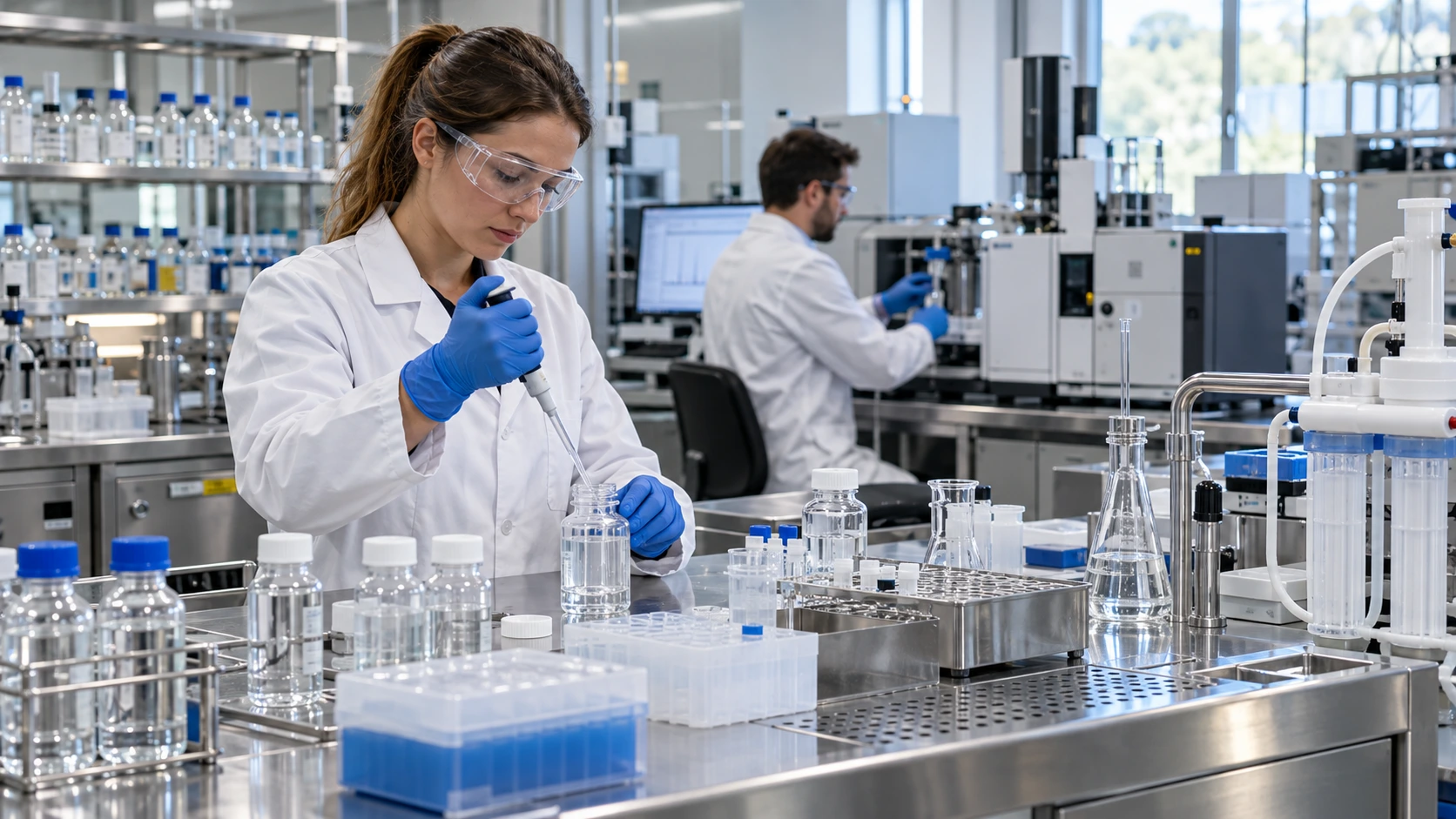
Most people who order a water test never see what happens after they mail the sample back. The bottle arrives, moves through preparation and analysis, then a review step, and eventually returns as a report full of measurements.
At ETR Laboratories in Leominster, Massachusetts, we do that work in our own water testing lab, using different instruments and methods depending on what your sample is being tested for. This article takes you onto the lab floor to meet the people who handle your sample and the instruments they use, along with the quality checks behind each result.
For the full customer journey, including sample collection and report delivery, our walkthrough of how ETR tests your water covers each stage in order.
Four points explain what happens to your sample once it reaches the bench:
No single instrument can test water for everything, so one broad panel may pass through several instruments before its results come together in a single report. Each technique below measures a different group of contaminants.
Inductively coupled plasma mass spectrometry, or ICP-MS, measures many metals at very low concentrations, often down to parts per billion. That sensitivity makes it a strong fit for trace metals, where health-based limits tend to sit at very small numbers.
A related technique, ICP-OES, handles minerals that show up at higher concentrations, such as calcium and iron. Pairing the two lets the lab cover trace metals and common minerals in the same panel without pushing either instrument outside its best working range.
Gas chromatography-mass spectrometry, or GC-MS, separates a mixture of organic compounds before identifying and measuring each one. Volatile organic compounds, which can come from fuels and industrial solvents, are a common target for this kind of analysis.
Bacteria testing depends on growth. In membrane filtration, a measured volume of water passes through a fine filter that traps bacteria, and the filter then sits on a nutrient medium inside an incubator for roughly 24 hours before an analyst counts the colonies. That incubation period is why a bacteria result can’t come back the same day.
You don’t need to memorize any of these names. The useful part is knowing that the water testing methods behind a broad panel change line by line, and each one has to fit what’s being measured.
Quality control is how the lab confirms an instrument’s number is trustworthy before it appears on your report. Depending on the method, analysts run control samples alongside customer samples, and common examples include:
An instrument will still produce a number when something has gone wrong, which is why these checks run beside the work itself. We also keep a full-time quality control specialist on staff whose job is reviewing this work, and we take part in voluntary proficiency testing that benchmarks our results against labs nationwide.
Want to see what your own sample’s journey looks like? Order a water test kit matched to your water source, and our team will walk you through the results once they’re ready.
A failed control flags data for a closer look before anything is reported. It does not automatically mean your water result is wrong.
When a control falls outside its acceptance range, lab staff review the run and investigate the cause. From there, they may take corrective action or reanalyze the sample before the result is released. ISO/IEC 17025 expects accredited labs to keep documented procedures for work that doesn’t meet requirements and to record the actions taken.
Acceptance limits and rerun rules depend on the method, so no single cutoff applies to every analysis. For you as a customer, the point of the process is simple: questionable data gets caught at the bench before it can reach your report.
Accreditation means an outside body has assessed a water testing lab against a published standard, so a quality claim can be checked by someone other than the lab making it.
We hold ISO/IEC 17025 accreditation through the ANSI National Accreditation Board (ANAB) for the testing listed on our scope of accreditation. The standard covers laboratory competence, including methods, equipment calibration, records, and how results are produced and reviewed. Assessments include on-site visits where auditors interview staff and examine equipment, along with a review of test documentation.
For environmental lab accreditation, NELAP is another common route, run through The NELAC Institute. Under that program, state agencies serve as the accreditation bodies, and many states accredit labs only in certain areas such as drinking water.
Both routes grant accreditation test by test. A lab accredited for one parameter isn’t automatically accredited for another, and no line on a website changes that. If you need results for a lender or a regulator, confirm that your specific analysis appears on the lab’s current scope. ANAB publishes directories of the organizations it accredits, so you can look up a lab’s scope for yourself.
By the time your report arrives, most of the work behind it is out of sight. You see the final measurements, while the calibration checks and duplicate runs stay in the lab’s records.
Understanding how water samples are analyzed gives you context for the numbers on the page. The next step is reading them, and our guide to reading a water test report walks through each column line by line. If you’re still deciding what to test for, our water quality testing guide helps you match a panel to your concerns.
The answers below cover questions we hear about the lab itself.
We run our own laboratory and perform nearly all of our testing in-house. The one exception is PFAS testing, which goes to a single independent accredited laboratory we selected for that analysis.
A broker model works differently. The company that sells you the test forwards your sample to another lab for analysis. That doesn’t make every broker unreliable, but you should ask who receives and analyzes your sample and which credentials apply to that facility.
Our Leominster facility is a working laboratory, so don’t assume walk-in tours are available. If you’d like to visit, contact our team before making plans and we can tell you what’s possible.
Accreditation runs on a cycle of periodic reassessment. Accreditation bodies return to confirm that a lab still meets the standard and its listed scope, and those reviews include on-site assessments. The exact schedule depends on the accreditation body and program, so check the lab’s current certificate and scope for effective dates.
The instruments and quality checks covered here are one part of what stands behind a result. ETR’s guide to what makes a water testing lab certified explains what accreditation and certification cover and how to verify a lab’s credentials for yourself.
When you’re ready to test, start with the question you want answered, then choose a panel that fits that purpose.
Choosing ETR Laboratories puts your sample in the hands of an accredited team. Our analysts run every test with built-in quality checks. You get clear, reliable results for your home, business, or property.
Order a water test kit matched to your water source today. Our team walks you through the results once they are ready.