
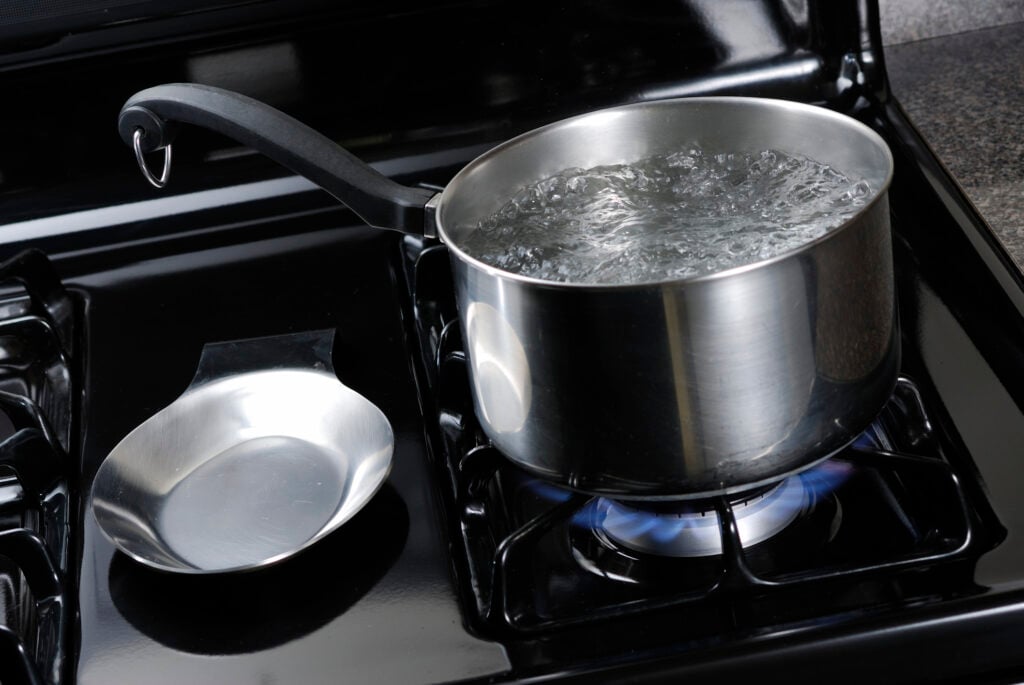
Boiling water is a common practice for water purification, especially when a water utility announces a problem in the water system. You may get boil-water alerts from your local water utility after extremely heavy rains, floods, or if a water main breaks. When this happens, you may be instructed to heat your drinking water to a rolling boil to kill bacteria, viruses and other tiny organisms that can make you sick.
However, boiling does not remove chemicals, heavy metals, or minerals from the water—in fact, it makes them stronger by concentrating them. At ETR Laboratories, we are dedicated to helping homeowners across the U.S. maintain a healthy supply of drinking water for their families. That’s why we’re here to explain the best way to keep toxins out of your water supply and whether or not boiling water can help.
What Does Boiling Water Actually Do?
Boiling water means heating it to 212 degrees, so you achieve what’s called a rolling boil, a vigorous boiling action. Continued for at least a full minute, that will kill microorganisms in the water that could make you sick.
That’s at or near sea level, however. At higher elevations, like in the Rockies or Appalachians, air pressure is lower, so water boils at a cooler temperature—around 202°F at 5,000 feet of elevation. That means you need to boil the water longer, about three full minutes, to kill tough germs safely. The EPA says this practice is effective in protecting your health if there is an outbreak of E. coli, norovirus, or Giardia from floods, sewage spills, or well contamination in your area.
Boiling doesn’t eliminate anything that is dissolved in the water, like toxic materials from factories, farms, old pipes or floods. These substances aren’t affected by boiling, and if some water is boiled away as steam, the toxins that remain are simply more concentrated in the remaining water.
What Contaminants Does Boiling Remove?
Boiling is effective against germs you can see under a microscope:
- Bacteria: Tiny one-celled bugs like E. coli come from sewage or animal waste. Salmonella can come from farm runoff. They die after one minute of boiling.
- Viruses: Smaller pathogens like norovirus that cause stomach flu can be eliminated.
- Protozoa: Bigger germs like Giardia or Cryptosporidium from wild animals, lakes, or bad wells are also killed.
- Remember, at higher elevations, you need three minutes to kill these microorganisms.
Will Boiling Water Remove Chlorination?
Boiling water partially removes chlorine used for municipal water disinfection because the chlorine evaporates as the water boils. However, boiling does little to eliminate chloramine (another disinfectant) or disinfection byproducts like trihalomethanes (THMs). Let’s take a more detailed look at these chemicals.
Chlorine Removal
Chlorine is volatile, which means that it easily turns into a gas and is released during boiling. A 15-20 minute rolling boil can reduce it by 50-90%, improving taste and odor. However, this process is inefficient as a lot of water is boiled off during this process. It also uses a lot of energy to maintain the boil
Chloramine Persists
Chloramine is a combination of chlorine and ammonia. More than 30% of U.S. water systems use this chemical for longer-lasting disinfection. Some systems cycle between chlorine and chloramine and will often announce the shift from one to the other. Chloramine won’t be released from the water during boiling.
Disinfection Byproducts Also Remain
Many people are concerned about the byproducts of chlorination or chloramine. When these disinfectants mix with plant or soil matter in the water, new substances are created: trihalomethanes (THMs) and haloacetic acids (HAAs). They are not easily released during boiling and so will just become more concentrated the longer the boil continues. These byproducts have been linked to cancer, reproductive problems and organ damage.
Practical Advice
Short boils (one to three minutes for pathogens) remove small amounts of chlorine. Extended boiling risks concentrating non-volatile contaminants like chloramine, disinfection byproducts or a very long list of other possible contaminants. If you are simply trying to remove disease-causing microorganisms, reverse osmosis is a better choice.
Think of it this way: the technology exists to correct almost any water problem you may have. The starting point is to know exactly what’s in your water. You can then develop the process or the filtration system you need to turn that water into a healthy supply for your water.
What Contaminants Does Boiling Leave Behind?
Most tap water problems come from contaminants that are not alive and therefore can’t be killed by boiling. For example:
- Heavy metals: Lead from pipes or connections in the plumbing system; arsenic from natural deposits near the water source or pesticides; or mercury from industrial pollution. These won’t boil off.
- Chemicals: Nitrates from farm fertilizers; fluoride added by municipal systems; PFAS, known as “forever chemicals” because some don’t break down for a century or more, sourced from factories and firefighting foam; pesticides from crops; drugs from manufacturers or unsafe disposal by patients. You don’t want these in your water.
- Minerals: Calcium and magnesium, which make water “hard,” leaving white scale on faucets and in kettles. Sodium, potassium and other minerals just remain in the water as it boils. Too much of these minerals can create expensive problems.
These are all dissolved solids. As the water boils away, they are going to remain in their solid state.
Does Boiling Concentrate Contaminants?
Picture this: Bring a quart of water to a boil. Stir in a half-cup of salt and keep stirring until the salt is dissolved. Keep boiling the water until there is half a quart of liquid left. You now have a half-cup of salt dissolved in two cups of water. It’s going to taste far saltier than the original pot of salty water. Solids remain. Some contaminants that turn to gas easily (like chlorine) may be partially released. Boiling is not an effective way to remove anything that isn’t living or doesn’t easily turn into a gas.
When Should You Boil Water?
Boil water when local cities, counties or water services say to. This can happen after water main breaks, big storms, floods, wildfires or water system repairs that cause water pressure loss. A local outbreak of a contaminant like E. coli can also trigger a boil advisory.
Insist on boiled water for any of these uses:
- Drinking
- Preparing coffee, tea, cocoa or other drinks
- Preparing baby formula
- Making any food for infants (use cooled boiled water).
- Brushing teeth
- Rinsing your mouth
- Cooking
- Washing fruits or vegetables
- Making ice cubes
- Providing pets with drinking water
- Washing hands before eating
What Other Alternatives Are There Than Boiling?
Whether you need to remove microorganisms, unwanted minerals or toxins, there is a filtering system suited to your needs. Here are your main choices:
Activated Carbon Filters: In pitcher or faucet attachment form, carbon grabs chlorine, bad tastes, and some chemicals like pesticides. Water flows through the charcoal which acts like a sponge, soaking up stuff you don’t want to drink. You’ll need to change the filter every six to 12 months, depending on your use.
Reverse Osmosis (RO) Systems: These systems remove the longest list of contaminants. Water squeezes through a tiny membrane under pressure, leaving 95-99% of junk behind. An RO system removes lead, fluoride, nitrates, PFAS, and salts. It even removes the minerals that create hard water. There are whole-house or under-sink models. RO systems do result in wasted water; however, the systems are getting more efficient, so less water goes down the drain.
Ultraviolet Disinfection Lights: In this system, water is exposed to germ-killing UV rays. No chemicals or boiling is needed. Pair a UV light with a reverse osmosis system for excellent protection. UV can kill E. coli, Salmonella, Legionella, Shigella, Campylobacter, norovirus, rotavirus, Hepatitis A, poliovirus, Giardia, Aspergillus, Candida and more.
Water Softeners: This system swaps calcium for salt. Your house will stop developing scaly deposits on or in your plumbing system and fixtures. However, it will not remove contaminants or microorganisms that could harm health.
Distillers: A distiller boils the water and then collects the steam, turning it back into water to provide you with pure drinking water. It removes almost everything but it is slow and consumes a lot of energy.
What Other Contaminants Might I Want to Eliminate?
Across the U.S., the problems with water vary greatly. Agricultural areas have different problems than industrial areas and neighborhoods next to military bases or landfills. No single method of filtration will remove everything. But remember, boiling water will just concentrate contaminants from these areas.
- Nitrates leak into water from agricultural fertilizers and septic systems. Reverse osmosis or anion-exchange filters can remove them.
- Lead gets into water from old plumbing pipes and solder as well as natural deposits. Carbon and ion-exchange filters that are NSF/ANSI 53/58 certified to remove lead remove it. Reverse osmosis and distillation also remove it.
- Hard minerals are naturally occurring. Showering in hard water dries skin and hair, builds up in pipes and any appliances that utilize water. Ion-exchange softeners remove excessive minerals.
- Arsenic is also naturally occurring, but also comes from pesticides and fertilizers, mining and wood preservatives. Reverse osmosis, ion-exchange and activated alumina filters can remove it.
- PFAS are called “forever chemicals” because they can take a century or longer to break down into harmless substances. Lengthy exposure to PFAS has been linked to cancer and weakened immune systems. They can be removed by carbon filters certified to address these contaminants. Look for NSF/ANSI 53/58 certification. Reverse osmosis and ion-exchange can also remove them.
- Fluoride is added to water by many cities and county systems. Reserve osmosis can remove it.
- Volatile organic chemicals consist of a long list of industrial chemicals, including benzene, vinyl chloride, toluene and trichloroethylene. Look for carbon block filters and granular activated carbon that are certified to remove these VOCs.
- Note that boiling removes none of these contaminants. It only concentrates them.
Note: An Important Fact About Water Contamination
Most of the time, you won’t even know these unwanted substances are in your water! Most have no taste and no smell. The only way to find out if you need to boil or filter your water is to professionally test your water to get accurate results.
How Often Should I Test My Water?
That depends on whether you depend on well water or municipal water.
- Well water: Start with a comprehensive test and then do a basic test yearly to check for change. Do not rely on inexpensive home improvement store tests that do not provide detailed results, as these won’t give you a clue as to how healthy your water is. Do a more basic test every year.
- Municipal water: Check water quality every three to five years; after plumbing repairs or installations are done; if your municipal system has reported any breakdowns or has notified you of the need to boil your water.
- Repeat tests when you move into a new home, if there have been extensive repairs or water has an odd taste or becomes cloudy or colored. Remember that contaminants can come from inside the house, from plumbing pipes, water heaters, trapped pockets of water in the system or new installations.
ETR Laboratories Gives You the Results That You Need
Whatever your water supply is, when you need accurate results to protect the health of your family, trust ETR Laboratories. Every year, thousands of homeowners, cities, counties and businesses count on ETR Laboratories to help them maintain the purity of their water.
ETR Laboratories offers a choice of nearly 100 different tests, from PFAS to lead; from heavy metals to mold. If you’re just starting out, the Premium Water Test looks for 113 different substances or characteristics (such as pH, cloudiness and more). Get started on the right test for your water now.
You’ll find out exactly what is in your water, how much of it is present, and what the acceptable standard for those contaminants is. In most cases, this standard is set by the Environmental Protection Agency. This profile empowers you to choose the best filtration system for your home.
You can’t rely on boiling to make your water healthy. Learn what’s in your water and that can guide your choice of filtration. Start today!
