Algal Blooms and Cyanotoxins in Water Supplies
Every summer, as lakes and ponds warm up, you’ll start
Free Shipping on Orders of $100 or More
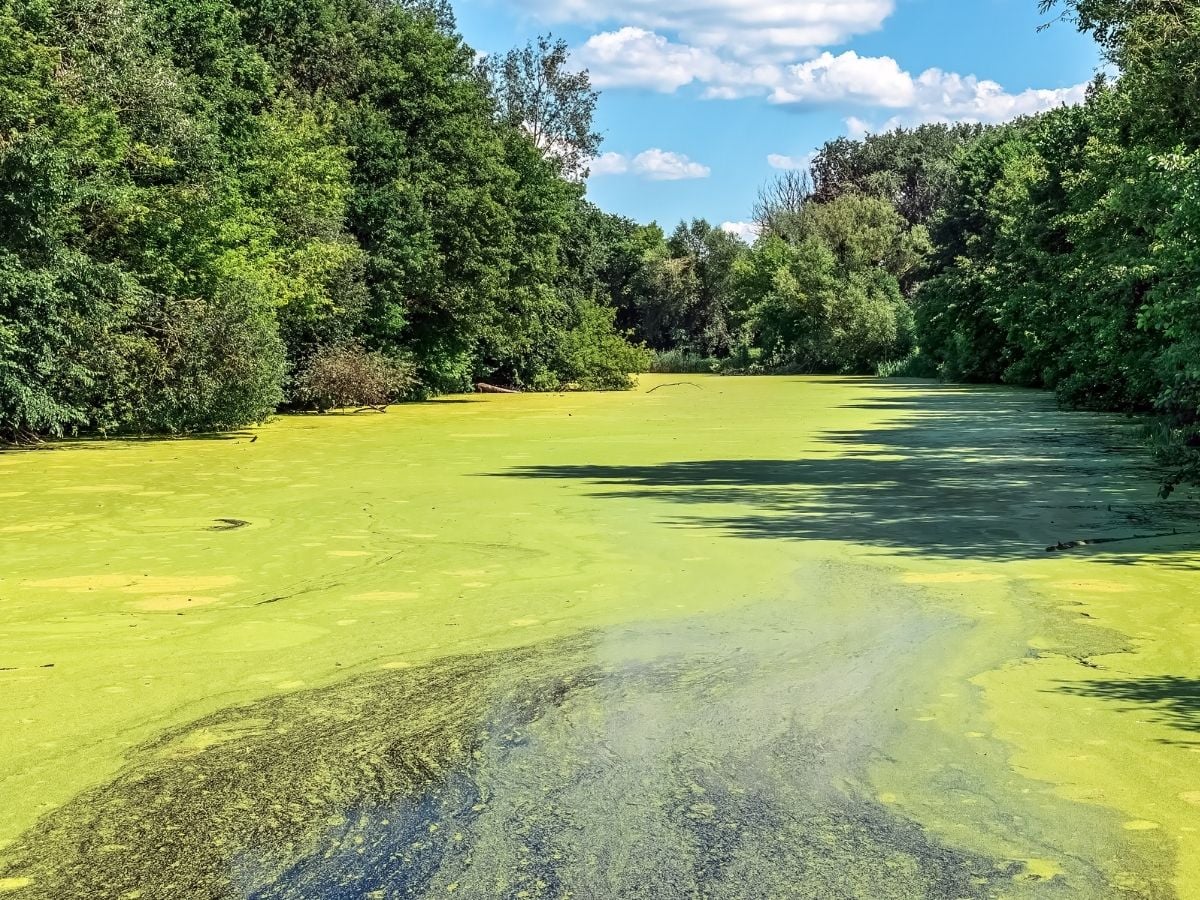
Every summer, as lakes and ponds warm up, you’ll start seeing the headlines: a beach closed for a “harmful algal bloom,” a lake advisory warning people and pets to stay out of the water. If you live near one of these water bodies, or your well draws from an aquifer close to a lake or reservoir, it’s worth understanding what’s actually happening and whether it’s something you need to think about at home.
The term “algal bloom” gets used loosely, but the real health risk comes from one specific group: cyanobacteria, sometimes still called blue-green algae. Cyanobacteria live naturally in lakes, ponds, and slow-moving rivers, but given the right conditions, warm water, plenty of sunlight, and a supply of nutrients like nitrogen and phosphorus (often from agricultural runoff or fertilizer), they multiply rapidly and form dense, visible blooms.
Not every bloom is dangerous. Ordinary green algae can look similar and cause taste, odor, and clarity issues, but it isn’t generally known to produce toxins. Cyanobacteria are the ones capable of producing cyanotoxins, and a bloom only earns the label “Harmful Algal Bloom,” or HAB, when it has the potential to actually produce those toxins and affect human health, animal health, or the surrounding ecosystem.
Rather than talk about “toxins” in the abstract, it helps to know the specific ones public health agencies actually track:
The EPA has issued national Health Advisory levels for microcystins and cylindrospermopsin in finished drinking water. For microcystins, the level is 0.3 micrograms per liter for children five and under and pregnant women, and 1.6 micrograms per liter for school-age children and adults. For cylindrospermopsin, it’s 0.7 micrograms per liter for the younger, more sensitive group, and 3.0 micrograms per liter for everyone else. It’s worth being precise about what these numbers actually are: they’re non-regulatory guidance levels EPA issued to help interpret results, not enforceable legal limits. There’s currently no federal Maximum Contaminant Level for any cyanotoxin under the Safe Drinking Water Act.
To put the scale of this in perspective without overstating personal risk: EPA’s National Lakes Assessment found detectable microcystins in roughly one out of every three lakes sampled nationally on the day of sampling. This is a real, fairly common phenomenon, not a fringe concern, but it’s also not something that should read as alarming for most people most of the time.
Certain groups face higher risk from cyanotoxin exposure: infants, young children under six, pregnant and nursing women, people with existing liver conditions, dialysis patients, and the elderly. If you fall into one of these categories and live near a lake or reservoir with a known history of blooms, it’s worth being more attentive to local advisories during bloom season.
Public water systems that draw from surface water sources near lake and reservoir blooms are required to monitor for cyanotoxins and treat accordingly, so those systems are being actively managed during an active bloom. The real gap is homes on private wells or private water intakes located close to a lake, pond, wetlands, or a reservoir with a bloom history. Those systems don’t have the same built-in oversight a public water system does, and there’s genuine, documented uncertainty about water quality at those properties during active bloom events.
This isn’t a reason to panic if you’re in this situation. It’s a reason to treat testing as a smart, proactive step rather than an afterthought, especially heading into the warmest months of the year.
Not everyone who searches this topic is worried about a confirmed toxin. Plenty of people are just noticing something has changed with their water. Harmful algal blooms commonly cause earthy or musty tastes and odors, and on their own, those changes don’t necessarily mean anything dangerous is present. But it’s a completely legitimate, common reason to want an answer instead of guessing, especially if the smell or taste shows up around the same time every summer.
Cyanotoxins and the organisms that produce them can be identified a few different ways. ELISA testing is faster and more accessible, and it’s the method behind EPA Method 546, which detects “total microcystins” by targeting a chemical structure shared across most microcystin variants. It’s a well-established, legitimate method, though it gives a group-level result rather than pinpointing one exact toxin variant. LC-MS/MS is the more precise alternative, capable of identifying specific individual toxins at very low concentrations, sometimes testing for several different cyanotoxins in a single run. There’s also scanning electron microscopy (SEM), which takes a different approach entirely: rather than measuring toxin concentration directly, it identifies the actual organism present in the water sample, confirming if the cyanobacteria species capable of producing these toxins are there in the first place.
ETR Laboratories offers an Algae & Cyanotoxins Test for homeowners who want a direct answer rather than a guess, whether that’s prompted by a nearby lake advisory, an unusual taste or odor, or simply wanting peace of mind heading into bloom season. As with all of our testing, results come with a free expert consultation, so you’re not left interpreting a lab report on your own.
If you’re on a private well near a lake or reservoir with a history of blooms, or you’ve noticed a change in taste or smell this time of year, testing is the way to actually know what you’re dealing with, rather than waiting to see if it resolves on its own.
From the Lab by ETR Laboratories
Every summer, as lakes and ponds warm up, you’ll start
If you’ve seen headlines this summer about a fast-growing outbreak
Run a glass through the dishwasher and pull it out
Related Post.
Algal Blooms and Cyanotoxins in Water Supplies
Every summer, as lakes and ponds warm up, you’ll start seeing the headlines: a beach
The 2026 Cyclospora Outbreak: What It Actually Means for Your Water
If you’ve seen headlines this summer about a fast-growing outbreak of diarrheal illness sweeping across
White Residue on Fixtures and Dishes: What It Means
Run a glass through the dishwasher and pull it out cloudy. Wipe down the shower
Water Testing Labs Near Me: How to Choose the Right Lab
A search for water testing near you usually turns up dozens of companies claiming to
Whole-House Reverse Osmosis System vs. Under-Sink RO
From the Lab by ETR Laboratories Reverse osmosis has been a common option for treating
Tannins in Well Water: Causes, Signs, and Treatment
Most people would blame the presence of iron when they see their water take on a yellow or tea-colored tint. Maybe your white laundry is slowly turning beige, or you have noticed an earthy smell coming from the tap.
What Are Emerging Contaminants? Types, Sources, and Risks – 2026
It’s almost natural to pinpoint lead or bacteria as typical water contaminants since they have been part of the public conversation for decades, but scientists have now begun paying attention to a different group of substances called emerging contaminants.
Legionella in Water: Home Plumbing and Water Heater Risks
It’s easy to assume nothing is wrong inside your pipes if your water looks clear and tastes normal. Most people overlook the effects of Legionella in water for exactly that reason. It’s a kind of bacteria that can build up inside home plumbing
The World Health Organization Just Updated Its Drinking Water Guidelines. Here’s What It Means.
On June 18, 2026, the World Health Organization released an updated edition of its Guidelines for Drinking Water Quality, the most authoritative global reference document on what safe drinking water actually means and how to achieve it
What a Polluted San Diego Bay Tells Us About the Water Closest to You
Mission Bay in San Diego draws an estimated 15 million visitors a year. It’s one of the most popular recreational water destinations in the country. And according to a report released in June 2026, it has a serious water quality problem that isn’t going away when it stops raining.
Last Friday night, during a torrential rainstorm, a 42-inch sewer force main near Haverhill’s main pumping station failed. The pipe, which carries wastewater from the city’s main pump station to its treatment plant, dates back to the 1970s.
On June 5, 2026, residents in nearly a dozen neighborhoods in Northwest Washington DC started noticing something wrong with their water pressure. DC Water received calls from customers experiencing low to no pressure at multiple locations at the same time the Fort Reno Pumping Station was experiencing fluctuating power issues, with a full loss of power hitting at around 12:30 p.m.
Related Post.

If you've seen headlines this summer about a fast-growing outbreak of diarrheal illness sweeping across the country, you're not imagining...

Run a glass through the dishwasher and pull it out cloudy. Wipe down the shower door and watch a chalky...

A search for water testing near you usually turns up dozens of companies claiming to offer laboratory testing, but not...