Algal Blooms and Cyanotoxins in Water Supplies
Every summer, as lakes and ponds warm up, you’ll start
Free Shipping on Orders of $100 or More
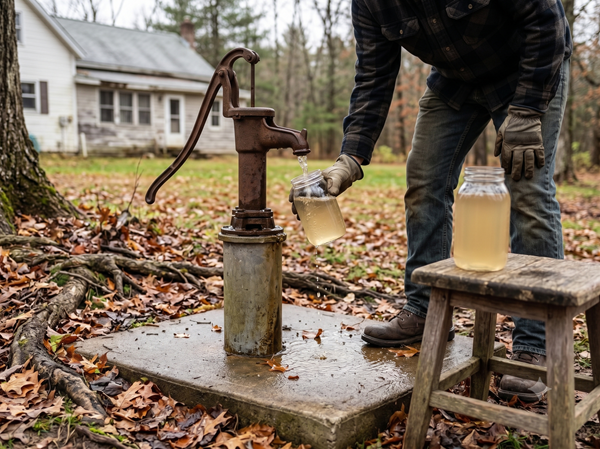
Most people would blame the presence of iron when they see their water take on a yellow or tea-colored tint. Maybe your white laundry is slowly turning beige, or you have noticed an earthy smell coming from the tap.
Another naturally occurring substance could be responsible for that, though: tannins in well water.
Tannins are natural organic compounds released as fallen leaves and roots decay in the surrounding soil. They can discolor well water without making it unsafe to drink. They are also so often mistaken for iron that identifying the true cause is worth doing before you choose a treatment system.
Tannins in well water are natural organic compounds that leach into groundwater as fallen leaves and roots break down in the surrounding soil.
Shallow wells tend to pick up tannins more often than deeper wells, since they sit closer to the topsoil and organic matter that produce them. The compounds work much like tea leaves steeping in hot water, releasing color as they break down and dissolve into groundwater.
The most common sign of tannins in well water is a yellow or brown tint that shows up as soon as you turn on the tap. Beyond that first sign, tannins tend to show up in a few consistent ways:
Tannins can leave a visible mark on several parts of a home:
Some homeowners notice an earthy smell or a slight change in taste, though this symptom shows up less consistently than visible discoloration. The odor tends to become more noticeable in warmer months, when higher water temperatures can intensify smells that are barely detectable in the winter.
The clearest way to tell tannins and iron apart is to watch how the discoloration behaves in a glass of water left standing overnight. Confirming which one you are dealing with comes down to two steps:
Fill a clear glass with water straight from the tap and let it sit overnight. If the discoloration settles to the bottom, iron or sediment is the more likely cause. If the color stays suspended throughout the glass, tannins are the more likely explanation. A glass jar with a wide opening works better for this test than a narrow cup, since it makes any settling easier to see against the light.
The glass test offers a useful first read, but multiple contaminants can exist in the same water supply at once. Laboratory testing identifies exactly what is present, which allows you to choose a treatment system that targets the right problem instead of guessing. ETR Laboratories can run this kind of testing to confirm whether tannins, iron, or a combination of both is affecting your water.
Tannins are generally not considered harmful at the levels typically found in well water. That answer breaks down into two parts:
At typical concentrations, tannins are mostly an aesthetic issue rather than a health hazard. They affect color and odor more than they affect safety, along with taste in some cases.
Discoloration can occur alongside other contaminants that do carry health implications, so testing confirms what is present rather than leaving anything to assumption. Discolored water should never be assumed safe based on tannins being a likely explanation.
Removing tannins from well water usually comes down to one of three treatment approaches, depending on how severe the discoloration is:
Anion exchange is the most common treatment for tannins. It uses a specialized resin designed to attract and remove organic compounds, which sets it apart from a traditional water softener built to handle hardness minerals instead. The resin periodically regenerates with a brine solution, similar to how a standard softener recharges, though the resin itself is formulated differently to target tannins specifically.
Activated carbon filters can improve taste and odor and often work well as a polishing step after another treatment method has addressed the bulk of the discoloration. On their own, they tend to suit lighter tannin levels better than heavily discolored water, since a high organic load can wear through the filter media faster than expected.
Chlorine oxidation can help break down tannins at higher concentrations, typically followed by filtration to remove what the oxidation process leaves behind. This approach tends to suit more severe cases rather than mild discoloration.
A standard water softener does not remove tannins on its own. The difference comes down to two types of systems:
Conventional softeners are built to remove calcium and magnesium, the minerals responsible for water hardness. Their resin is not designed to target organic compounds like tannins.
Specialized anion exchange resins can handle both hardness minerals and tannins in some systems, but this capability varies by product. Not every softener on the market removes tannins, so checking the specific resin type is worth doing before assuming your existing system will handle the job.
Yes, tannins can return after treatment, particularly if conditions in the surrounding groundwater change. A few factors can explain this:
Heavy rainfall and shifting groundwater movement can introduce new organic material into a well, which may bring tannins back even after a system has been working well. Spring thaw and periods of heavy rain tend to be the times homeowners notice this most, since surface water moves through the soil more actively during those stretches.
Filters need periodic replacement, and resin used in anion exchange systems requires its own maintenance schedule to keep working effectively.
Testing on an occasional basis helps verify that a treatment system is still performing as expected, rather than assuming it will keep working indefinitely without a check.
Several common misconceptions can steer homeowners toward the wrong treatment for tannins in well water. Three come up most often:
Appearance alone is not enough to identify the cause, since tannins and iron can produce a similar tint.
Boiling does not remove dissolved tannins. It can concentrate them instead, since some of the water evaporates while the tannins remain behind.
Discoloration is worth investigating, but it does not automatically signal a health hazard. Tannins are one of several possible causes, and testing is the only way to know which one applies to your water.
If you are unsure whether tannins, iron, or something else is behind your water’s color or smell, ETR Laboratories offers laboratory testing that can identify exactly what you are dealing with. Contact ETR Laboratories today to get a tannin water test for your well.
Every summer, as lakes and ponds warm up, you’ll start
If you’ve seen headlines this summer about a fast-growing outbreak
Run a glass through the dishwasher and pull it out
Related Post.
Algal Blooms and Cyanotoxins in Water Supplies
Every summer, as lakes and ponds warm up, you’ll start seeing the headlines: a beach
The 2026 Cyclospora Outbreak: What It Actually Means for Your Water
If you’ve seen headlines this summer about a fast-growing outbreak of diarrheal illness sweeping across
White Residue on Fixtures and Dishes: What It Means
Run a glass through the dishwasher and pull it out cloudy. Wipe down the shower
Water Testing Labs Near Me: How to Choose the Right Lab
A search for water testing near you usually turns up dozens of companies claiming to
Whole-House Reverse Osmosis System vs. Under-Sink RO
From the Lab by ETR Laboratories Reverse osmosis has been a common option for treating
Tannins in Well Water: Causes, Signs, and Treatment
Most people would blame the presence of iron when they see their water take on a yellow or tea-colored tint. Maybe your white laundry is slowly turning beige, or you have noticed an earthy smell coming from the tap.
What Are Emerging Contaminants? Types, Sources, and Risks – 2026
It’s almost natural to pinpoint lead or bacteria as typical water contaminants since they have been part of the public conversation for decades, but scientists have now begun paying attention to a different group of substances called emerging contaminants.
Legionella in Water: Home Plumbing and Water Heater Risks
It’s easy to assume nothing is wrong inside your pipes if your water looks clear and tastes normal. Most people overlook the effects of Legionella in water for exactly that reason. It’s a kind of bacteria that can build up inside home plumbing
The World Health Organization Just Updated Its Drinking Water Guidelines. Here’s What It Means.
On June 18, 2026, the World Health Organization released an updated edition of its Guidelines for Drinking Water Quality, the most authoritative global reference document on what safe drinking water actually means and how to achieve it
What a Polluted San Diego Bay Tells Us About the Water Closest to You
Mission Bay in San Diego draws an estimated 15 million visitors a year. It’s one of the most popular recreational water destinations in the country. And according to a report released in June 2026, it has a serious water quality problem that isn’t going away when it stops raining.
Last Friday night, during a torrential rainstorm, a 42-inch sewer force main near Haverhill’s main pumping station failed. The pipe, which carries wastewater from the city’s main pump station to its treatment plant, dates back to the 1970s.
On June 5, 2026, residents in nearly a dozen neighborhoods in Northwest Washington DC started noticing something wrong with their water pressure. DC Water received calls from customers experiencing low to no pressure at multiple locations at the same time the Fort Reno Pumping Station was experiencing fluctuating power issues, with a full loss of power hitting at around 12:30 p.m.
Related Post.

Every summer, as lakes and ponds warm up, you'll start seeing the headlines: a beach closed for a "harmful algal...

If you've seen headlines this summer about a fast-growing outbreak of diarrheal illness sweeping across the country, you're not imagining...

Run a glass through the dishwasher and pull it out cloudy. Wipe down the shower door and watch a chalky...