Algal Blooms and Cyanotoxins in Water Supplies
Every summer, as lakes and ponds warm up, you’ll start
Free Shipping on Orders of $100 or More
From the Lab by ETR Laboratories
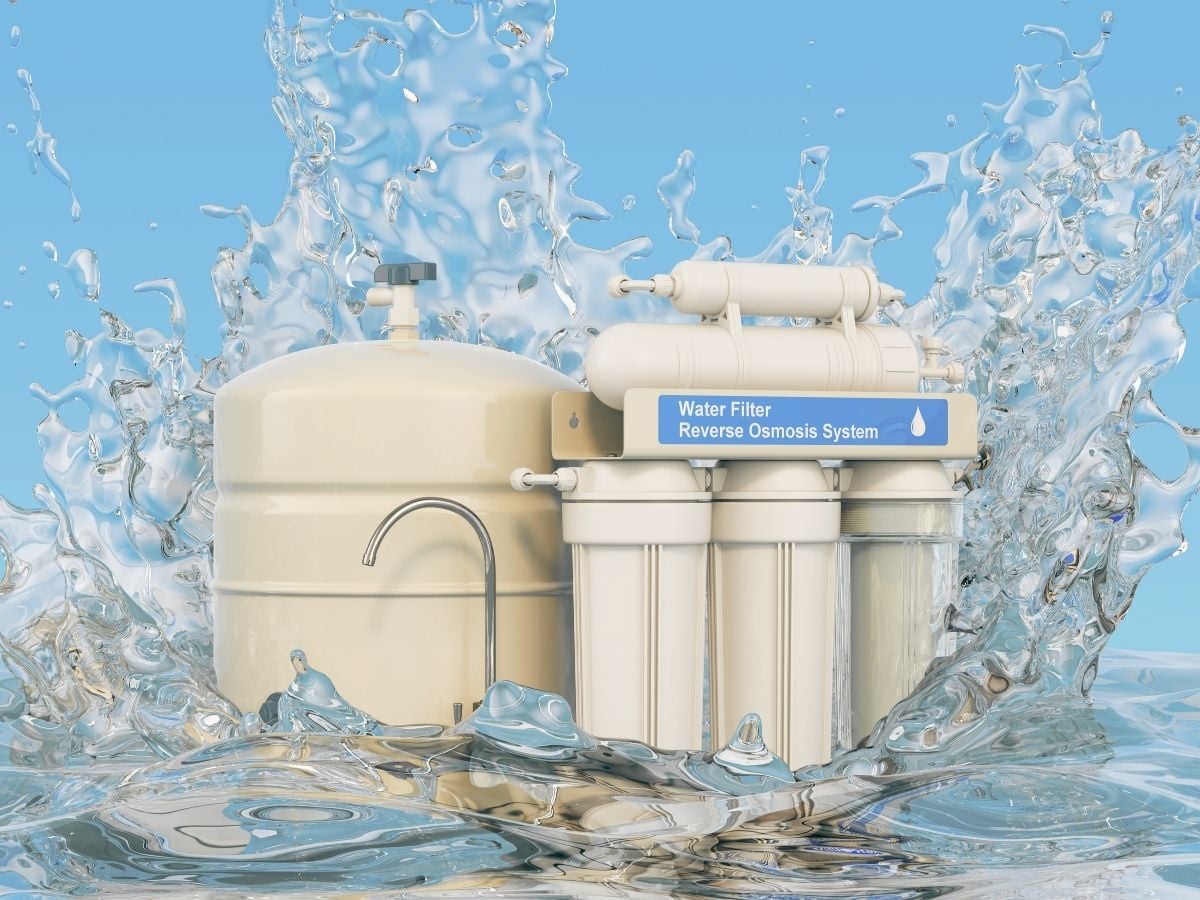
Reverse osmosis has been a common option for treating drinking water for decades, and if you’ve looked it up, you probably have run into two versions: whole-house systems and under-sink systems. A whole-house reverse osmosis system treats nearly all the water entering a home, while an under-sink RO system treats water at one dedicated faucet.
Both essentially rely on the same core technology but are built for very different jobs.
The right choice comes down to what’s in your water, how much of it you need treated, and what your home can support in space, plumbing, and budget. In this article, we’ll walk through how each system works, what they cost, and how to figure out which one fits your household.
A whole-house reverse osmosis system is a point-of-entry setup installed near the main water line, pressure tank, or mechanical room. It treats water before that water reaches any fixture in the home. Once installed, treated water can supply:
Not every “whole-house water filter” uses reverse osmosis, though. Many rely on carbon, sediment filtration, oxidation, or ion exchange instead.
| Factor | Whole-House RO | Under-Sink RO |
| Treatment location | Main water line | One point of use |
| Water treated | Most or all household water | One dedicated faucet |
| Primary purpose | Widespread water treatment | Drinking and cooking water |
| Storage | Large atmospheric tank | Small pressurized tank |
| Pump requirements | Usually needs repressurization | Often relies on supply pressure |
| Space needed | Basement, garage, or utility area | Under a kitchen cabinet |
| Installation | Professional design required | Often simpler, sometimes DIY |
| Upfront cost | Substantially higher | More affordable |
| Maintenance | More components, higher servicing cost | Fewer, smaller components |
| Best suited for | Severe, widespread dissolved contamination | Targeted drinking-water concerns |
Reverse osmosis pushes water under pressure through a semipermeable membrane, a barrier with pores small enough to block many dissolved contaminants.
In normal osmosis, water moves across a semipermeable membrane from an area with a lower concentration of dissolved substances toward an area with a higher concentration. Reverse osmosis applies pressure to push water in the opposite direction, separating it from many dissolved contaminants.
The membrane lets water molecules through while rejecting many dissolved substances, and the rejected concentrate leaves through a separate drain line.
Depending on the membrane, pretreatment, and contaminant levels, RO may reduce:
No membrane addresses every contaminant equally, so results depend on the specific setup.
The membrane’s pathways are extremely small, so water has to be forced through under pressure rather than flowing freely. That makes RO production far slower than the flow from a shower or kitchen faucet.
A slow rate is easy to manage when a system only fills a small drinking-water tank. It becomes a much bigger engineering problem when the system has to supply an entire house, and that single fact shapes nearly everything else in this comparison.
A whole-house setup compensates for slow membrane production with storage, pumps, and pretreatment equipment. Water filters continuously in the background and gets stored ahead of demand rather than produced on the spot.
That background production has to keep pace with everyday household use, which is where the supporting equipment comes in, such as:
A whole-house system typically needs a large atmospheric tank, often 150 to 500 gallons depending on household size, daily use, and membrane recovery rate. A household running a shower, flushing a toilet, and starting a washing machine at the same time would outpace the membrane alone, so the tank holds treated water in reserve.
Stored water needs a pump to move it back into the household plumbing at usable pressure. A standard showerhead alone uses about 2.5 gallons per minute, and several fixtures running at once, like a shower, dishwasher, and sink during a morning routine, can call for a pump rated at 10 to 15 or more gallons per minute to keep pressure from dropping.
RO membranes can be vulnerable to hardness, iron, manganese, sediment, chlorine, and microbial fouling. Depending on what testing finds, a home may need sediment filtration, carbon filtration, water softening, iron or manganese treatment, or disinfection installed upstream of the membrane. RO does not automatically replace these other treatment steps.
Between the membrane unit, storage tank, booster pump, and pressure tank, a whole-house setup typically needs 50 to 80 square feet of dedicated space, more than a basement corner or a spot under a sink.
An under-sink system treats water at one location, usually the kitchen, through a small dedicated faucet installed beside the regular one. The main faucet keeps supplying untreated household water as usual.
Because it only needs to support drinking and cooking demand, the system can fill a small tank gradually while the household isn’t actively drawing RO water.
A common city-water configuration includes:
Granular carbon and carbon block are both forms of activated carbon. Granular carbon handles bulk chlorine reduction and higher initial loading, while carbon block provides denser contact for finer polishing before the membrane takes over on dissolved substances that carbon alone can’t remove.
The right stage order depends on the source. Municipal water may need stronger chlorine and disinfection-byproduct treatment, while well water may need iron, manganese, hardness, or sediment treatment first. The correct configuration can’t be determined from a generic product listing. It depends on what testing finds.
Whole-house RO systems cost more because they’re custom-designed to meet a home’s water quality and demand. A base system with installation typically starts around $1,500 to $5,000+, while pretreatment for issues like hardness, iron, or manganese can add $1,000 to $3,000+. Larger, fully equipped systems can exceed $15,000 to $20,000, with annual maintenance typically costing $400 to $700.
Under-sink RO systems are much more affordable, usually costing $150 to $600 for the unit, plus $100 to $300 for installation if needed. Annual filter replacement typically runs $80 to $150. Because they only treat drinking and cooking water at one faucet, they require less equipment, space, and maintenance than a whole-house system.
Whole-house systems bring real tradeoffs alongside broader coverage:
Under-sink systems carry smaller versions of the same limitations:
A whole-house reverse osmosis system tends to make sense when testing confirms severe or widespread dissolved contamination that needs treatment throughout the home. It’s often unnecessary when the main goal is better drinking and cooking water at one faucet.
Whole-house RO is worth considering when:
Under-sink RO tends to be more practical when the concern is mainly drinking and cooking water, municipal supply is generally fine for bathing and laundry, or budget and space are limited.
And sometimes RO isn’t the right first move at all. A water softener usually addresses hardness more efficiently, activated carbon handles chlorine taste and odor, and iron, manganese, sediment, or microbial issues need their own dedicated treatment. The right system is the one that matches what’s in your water.
Yes. Test results determine what needs treatment, where it needs to happen, and whether RO is the right tool at all. Choosing a system based on taste, staining, a neighbor’s recommendation, or a generic online package skips the step that drives the decision.
A water test can identify total dissolved solids, hardness, iron and manganese, arsenic, lead, nitrates, fluoride, chloride, sulfate, pH, turbidity, bacteria, and other contaminants depending on your source. Each result points toward a different fix. High hardness may call for softening before RO ever enters the picture. Chlorine may only need carbon protection for the membrane. A contaminant tied to ingestion risk supports a point-of-use system, while a problem affecting bathing or appliances points toward point-of-entry treatment.
Because ETR Laboratories tests water and doesn’t sell filtration systems, you get recommendations built entirely from your own results.
Start with a test of your untreated water, then identify which contaminants need action and where the exposure happens. From there, estimate your household demand, confirm available installation space, and compare equipment, installation, and wastewater costs before choosing.
Choose under-sink RO for treated drinking and cooking water at one location. Consider whole-house RO when testing confirms serious dissolved contamination across the whole supply and your home can support the equipment it requires. If RO isn’t the most efficient fix for what testing turns up, another targeted technology may serve you better.
A whole-house reverse osmosis system can work well, but its cost and complexity make testing especially important before you commit. A lab analysis helps you avoid an oversized system, a missing pretreatment step, or RO for a problem another technology would solve more efficiently.
You can order in-house water testing from ETR Laboratories, backed by 31 years of experience, ANAB accreditation to the ISO/IEC 17025 standard for applicable testing, and a free consultation to walk you through your results before you invest in treatment. Contact us today.
Every summer, as lakes and ponds warm up, you’ll start
If you’ve seen headlines this summer about a fast-growing outbreak
Run a glass through the dishwasher and pull it out
Related Post.
Algal Blooms and Cyanotoxins in Water Supplies
Every summer, as lakes and ponds warm up, you’ll start seeing the headlines: a beach
The 2026 Cyclospora Outbreak: What It Actually Means for Your Water
If you’ve seen headlines this summer about a fast-growing outbreak of diarrheal illness sweeping across
White Residue on Fixtures and Dishes: What It Means
Run a glass through the dishwasher and pull it out cloudy. Wipe down the shower
Water Testing Labs Near Me: How to Choose the Right Lab
A search for water testing near you usually turns up dozens of companies claiming to
Whole-House Reverse Osmosis System vs. Under-Sink RO
From the Lab by ETR Laboratories Reverse osmosis has been a common option for treating
Tannins in Well Water: Causes, Signs, and Treatment
Most people would blame the presence of iron when they see their water take on a yellow or tea-colored tint. Maybe your white laundry is slowly turning beige, or you have noticed an earthy smell coming from the tap.
What Are Emerging Contaminants? Types, Sources, and Risks – 2026
It’s almost natural to pinpoint lead or bacteria as typical water contaminants since they have been part of the public conversation for decades, but scientists have now begun paying attention to a different group of substances called emerging contaminants.
Legionella in Water: Home Plumbing and Water Heater Risks
It’s easy to assume nothing is wrong inside your pipes if your water looks clear and tastes normal. Most people overlook the effects of Legionella in water for exactly that reason. It’s a kind of bacteria that can build up inside home plumbing
The World Health Organization Just Updated Its Drinking Water Guidelines. Here’s What It Means.
On June 18, 2026, the World Health Organization released an updated edition of its Guidelines for Drinking Water Quality, the most authoritative global reference document on what safe drinking water actually means and how to achieve it
What a Polluted San Diego Bay Tells Us About the Water Closest to You
Mission Bay in San Diego draws an estimated 15 million visitors a year. It’s one of the most popular recreational water destinations in the country. And according to a report released in June 2026, it has a serious water quality problem that isn’t going away when it stops raining.
Last Friday night, during a torrential rainstorm, a 42-inch sewer force main near Haverhill’s main pumping station failed. The pipe, which carries wastewater from the city’s main pump station to its treatment plant, dates back to the 1970s.
On June 5, 2026, residents in nearly a dozen neighborhoods in Northwest Washington DC started noticing something wrong with their water pressure. DC Water received calls from customers experiencing low to no pressure at multiple locations at the same time the Fort Reno Pumping Station was experiencing fluctuating power issues, with a full loss of power hitting at around 12:30 p.m.
Related Post.

Every summer, as lakes and ponds warm up, you'll start seeing the headlines: a beach closed for a "harmful algal...

If you've seen headlines this summer about a fast-growing outbreak of diarrheal illness sweeping across the country, you're not imagining...

Run a glass through the dishwasher and pull it out cloudy. Wipe down the shower door and watch a chalky...