Golf Course Pesticides and Your Well Water: What to Test
Field studies have found turf pesticides in some groundwater beneath

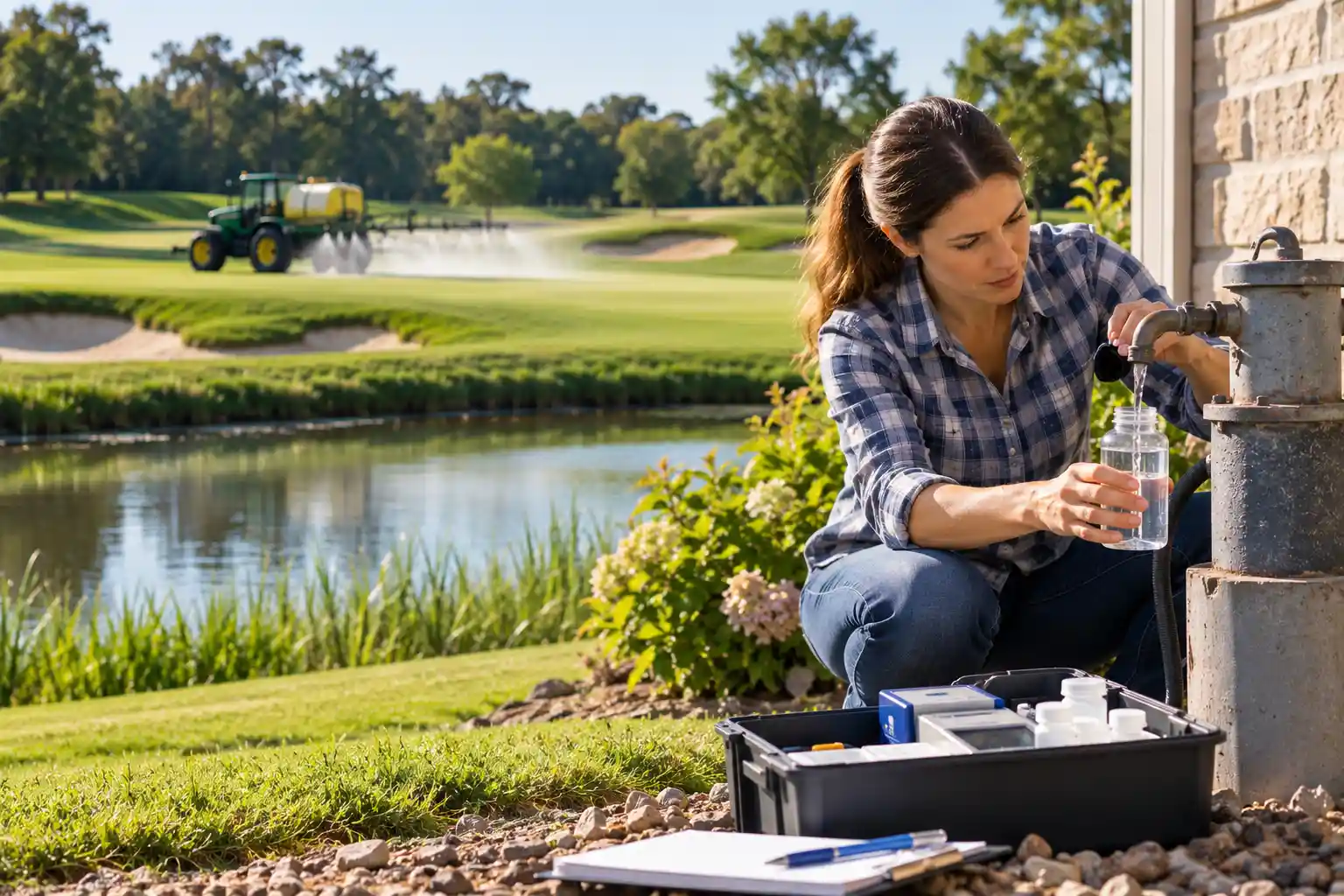
Field studies have found turf pesticides in some groundwater beneath golf courses, usually below health limits, and nothing we reviewed shows that golf course pesticide in well water is the rule. Your own well depends on the chemicals used, the soil, the well’s depth, and which way groundwater moves.
At ETR Laboratories, we test private wells for nitrate and pesticides, so we want to give you a plain reading of the evidence and a sensible way to check your water. In this article, we cover what studies found, which chemicals have EPA limits, what a detection would mean, and which tests to start with.
Living near a golf course can affect a private well, but the evidence is mixed and depends on the chemicals used, the soil, the depth of your well, and the direction groundwater flows.
We do not name courses, and nothing here suggests any particular well has been affected.
Four monitoring studies and reviews found turf pesticides in some groundwater, but only a small share of results went above health limits. The USGS study of Florida golf courses and the 1999 Cohen review offer the most detail we could confirm.
| Study | What it looked at | What it found |
| Cape Cod, Massachusetts (1990) | 19 monitoring wells on 4 golf courses, tested for 17 pesticides and related chemicals | Eight were detected, most often near greens and tees; chlordane was the only one above a health limit in some samples; nitrate was generally below 10 ppm |
| Florida, USGS report (1996) | Groundwater at 9 golf courses | Turf pesticides at 7 of 9 courses and in 52 percent of samples; 92 percent of occurrences were under the EPA limit or guidance level |
| Cohen and colleagues (1999) | Review of 17 studies covering 36 courses | 0.07 percent of groundwater samples exceeded a health limit; nitrate passed 10 mg/L in 3.6 percent, mostly tied to earlier farmland |
| Baris and colleagues (2010) | Review of 44 studies covering 80 courses | 0.15 percent of groundwater results exceeded a toxicity reference point |
The two reviews rely heavily on monitoring done to satisfy permits, and they share authors, so they work best as data points and not as final proof.
Courses use a range of fertilizers and pesticides, and only some of those compounds have a federal drinking water limit. The Florida study found eight pesticides in groundwater, including atrazine and simazine, and no source we found lists what every course uses.
Here is how several compounds compare with the limits the EPA sets for public water systems.
| Compound | EPA limit for public water systems |
| Nitrate (as nitrogen) | 10 mg/L |
| Atrazine | 3 ppb |
| Simazine | 4 ppb |
| 2,4-D | 70 ppb |
| Glyphosate | 700 ppb |
| Chlorothalonil | No EPA limit |
| Dicamba | No EPA limit |
Those limits bind public systems only. The EPA says private well quality is not regulated under the Safe Drinking Water Act or by most state governments, so testing is your decision. A limit shows what counts as high, but travel to your well depends on the ground in between.
There is no legal setback for a neighbor’s golf course, and no distance beyond which the risk drops to zero. Exposure to golf course runoff in groundwater depends on groundwater flow direction, how easily water moves through the soil, the aquifer type, and your well depth.
Groundwater generally moves downhill underground, so a well downgradient of a course sits in the path of water that has passed beneath it. Sandy, fast-draining soil lets dissolved chemicals move down quickly, and a 1994 modeling study of Long Island courses found sandy soils the most vulnerable to leaching. Plume lengths vary widely, since many are 250 feet long or less, while some have reached two to four miles.
Closer to home, you control the 100 feet around your own wellhead, which should stay free of fertilizer and pesticides.
Usually not by itself. A test tells you which chemical is present and at what concentration, but one result rarely identifies the source, since the same pesticide or nitrate can come from farming, lawn care, septic systems or past land use.
Here is the context that helps point toward a source:
A pesticide detection does not prove your neighbor’s course is responsible, and the usual steps for tracing a contamination source start with testing before anyone assigns blame.
A detection means a lab found a chemical, which is different from exceeding a limit. In the USGS study of domestic wells, man-made organic compounds such as pesticides and solvents showed up in about 60 percent of sampled wells, yet concentrations exceeded health benchmarks in under 1 percent. A trace detection therefore points to background use of many kinds.
Here is how the terms differ:
Nitrate is a separate case, since former farmland often explains it. In the Cohen review, most nitrate exceedances appeared linked to earlier agricultural use, and septic systems on neighboring land can add nitrate too.
A 2025 JAMA Network Open study found an association between living within one mile of a golf course and Parkinson’s disease in one region of Minnesota and Wisconsin, but it does not show cause and effect. The researchers did not measure pesticides in anyone’s water, and private-well users in the study had lower odds than people on public groundwater systems that contain a course.
Worry about golf course pesticides in your well water is reasonable, but living within a mile or several miles of a course does not mean your well is contaminated. Testing becomes more reasonable when one or more of these apply:
If you know which products the course uses, compare them with a lab’s analyte list before you order.
The right test depends on your concern, and a low-cost nitrate test is a sensible first step. Start with a nitrate test, then decide on a pesticide screen.
Nitrate is the fertilizer signal, and the EPA limit for public systems is 10 mg/L as nitrogen. Our Nitrate Water Test costs $35 and gives you a number to compare year to year, which beats a store-bought kit since home kits give only a rough estimate. Higher levels carry health concerns for infants under six months.
To test well water for pesticides, match the panel to your concern. Here is what each of ours includes:
Glyphosate, dicamba, MCPP and neonicotinoids are not listed on those product pages. If you need one, call our lab at (800) 344-9977 and ask about it, since we do not promise coverage we have not confirmed. You can also see how our Basic, Premium and Ultimate panels compare.
Here are the steps in order:
No. The EPA says the federal government does not regulate private well quality under the Safe Drinking Water Act, and most states do not either. Our overview of what to test for and how often is a good place to start.
Not in the study we found. A mid-1990s USGS report on Florida courses found pesticide-positive wells were significantly more common at courses irrigating with groundwater than with reclaimed water, though the authors noted that limited detections made firm conclusions difficult.
Check the result against any EPA limit for that compound, then retest to confirm it. Talk with your local health department, and consider treatment only after confirmation. We do not sell treatment systems, and our free consultation can help you read the report first.
There is no single distance. Travel depends on the chemical, soil permeability, flow direction and speed, rainfall or irrigation, aquifer conditions and well depth. A well is not safe simply because it sits a certain number of feet or miles away.
Only compounds on the lab’s analyte list can be reported, and a generic pesticide test does not cover every turf chemical. Ask for the list before you order. Our product pages list specific compounds, so we do not promise unlisted turf chemicals without confirming.
If there is a golf course near your well, a $35 nitrate test from ETR Laboratories gives you a baseline, and our Pesticides, Herbicides and Ultimate tests cover broader screens. Every order includes a free consultation with one of our water quality experts, and we are happy to talk through compounds not on our standard lists. Reach out today to find out which test suits your case.