
What Should You Test Your Home Water For? A Practical Guide
Most homeowners know they should test their water. Far fewer actually do it, and a big part of the reason is simply not knowing where to start. What contaminants matter? How often should you test? Is a $20 kit from the hardware store enough, or do you need a real lab?
This guide answers all of that plainly so you can stop guessing and start making informed decisions about the water your family drinks every day.
What Should You Test Your Home Water For? A Practical Guide
Most homeowners know they should test their water. Far fewer actually do it, and a big part of the reason is simply not knowing where to start. What contaminants matter? How often should you test? Is a $20 kit from the hardware store enough, or do you need a real lab?
This guide answers all of that plainly so you can stop guessing and start making informed decisions about the water your family drinks every day.
Why Home Water Testing Is Your Responsibility
If you are on a public water system, your utility tests and treats the water before it reaches your street but that does not mean what comes out of your tap is problem free. Aging pipes, local plumbing, and proximity to contamination sources can all affect water quality inside your home.
If you have a private well, the responsibility is entirely yours. The CDC is direct about this: private wells are not regulated, treated, or monitored by government agencies. What is in your water is your problem to find and fix.
Annual testing is not just a good idea. For well owners it is the baseline.
The Core Contaminants to Test For
The CDC recommends that private well owners test annually at minimum for total coliform bacteria, nitrates, total dissolved solids, and pH. The EPA echoes this guidance and notes that additional testing may be warranted based on your location and specific concerns. Here is what each of those means in plain terms along with a few other contaminants worth knowing about.
1. Bacteria — Coliform and E. coli
Bacteria testing is where most water safety conversations should begin. Total coliform bacteria are a broad indicator of whether outside contamination from surface runoff, septic systems, or wildlife is finding its way into your water supply. When coliform is detected, labs will typically follow up with an E. coli test to determine whether the contamination includes fecal matter. It sounds alarming, but identifying the problem is the first step to solving it.
2. Nitrates
Nitrates are strongly associated with agricultural runoff, fertilizer use, and septic system influence. They are on the CDC’s annual testing list for good reason and they matter beyond their direct health effects. Elevated nitrate levels are also a useful early warning sign that surface water may be infiltrating your well, which can mean other contaminants including bacteria are entering along with it.
3. pH
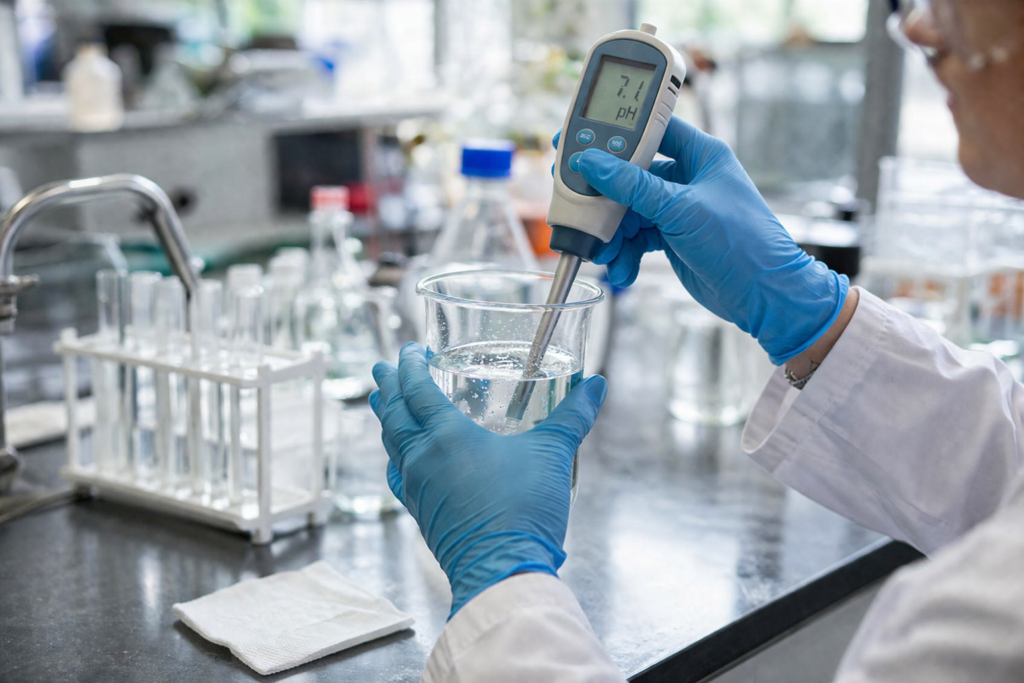
pH measures how acidic or alkaline your water is. While it is not always a direct health concern it has real practical implications. Acidic water can corrode pipes, leach metals like copper or lead into your drinking water, and affect how other contaminants behave. It is one of the cheapest and most useful things to know about your water.
4. Total Dissolved Solids
Total dissolved solids gives a general picture of how much dissolved mineral content is in your water. On its own a high reading does not necessarily mean your water is unsafe, but it provides valuable context that helps interpret other results and guides any treatment decisions.
5. Metals
Depending on your home’s age, location, and local geology, metals are one of the most important categories to include in a comprehensive test. Commonly tested metals include lead, arsenic, iron, manganese, and copper. Some metals affect taste, odor, and staining. Others like lead and arsenic are serious health concerns at elevated levels with no visible warning signs whatsoever. ETR Laboratories’ Premium Water Test screens for over 30 metals and minerals, giving you a thorough picture of what is in your water.
6. PFAS
PFAS, or per and polyfluoroalkyl substances, have become one of the most prominent water quality concerns in the country over the past several years. They have been found in water supplies near industrial sites, military bases, and even in rural and remote areas far from obvious sources. There is no way to detect PFAS without laboratory analysis. If you want a modern and complete understanding of your water quality, PFAS testing belongs in that conversation. ETR Laboratories’ PFAS Forever Chemical Drinking Water Test screens for 18 of the most concerning PFAS compounds in a single test.
7. Volatile Organic Compounds
VOCs are chemicals that can enter groundwater from fuel storage, industrial activity, solvents, and other environmental sources. For homes near industrial areas, older properties, or wells with any history of contamination concern, VOC testing is a smart addition. The Premium Water Test includes a comprehensive VOC panel covering over 60 industrial and cancer causing chemicals.
How Often Should You Test?
For private well owners the minimum is once per year for the core panel covering bacteria, nitrates, total dissolved solids, and pH. Beyond the annual test, additional testing makes sense after flooding or a significant storm event, if your water changes in taste, smell, or appearance, after any nearby construction, drilling, or environmental incident, when purchasing a home with a private well, or if a previous result came back with elevated levels of any contaminant.
At-Home Test Strips vs. Professional Lab Testing
Home test kits are convenient and better than nothing but they are significantly limited. They typically screen for a narrow set of contaminants, produce results that can be difficult to interpret, and rarely give you enough information to make confident decisions about your water.
Professional laboratory testing goes much further. A qualified lab analyzes your sample using calibrated instrumentation, measures a far broader range of contaminants, and delivers a detailed report you can act on. At ETR Laboratories every test comes with a free expert consultation so you are never left trying to decode your results alone.
Start With the Right Test
The best water test is not necessarily the smallest or cheapest one. It is the one that actually tells you what is in your water. For most homeowners that means starting with a panel that covers the core contaminants including bacteria, nitrates, pH, total dissolved solids, metals, and VOCs. The Premium Water Test from ETR Laboratories covers all of these in a single test. For full PFAS coverage, pair it with our PFAS Forever Chemical Drinking Water Test to get a truly comprehensive picture of your water quality.
Every ETR Laboratories test includes a free expert consultation with every order so you will always know exactly what your results mean and what to do next. Turnaround times vary by test and are listed on each product page, with many of our most popular tests returning results within just a few business days.
Have questions? Give us a call at 800-344-9977.
