Langelier Saturation Index: Is Your Water Eating Pipes?
Blue-green stains around a drain, a pinhole leak in a

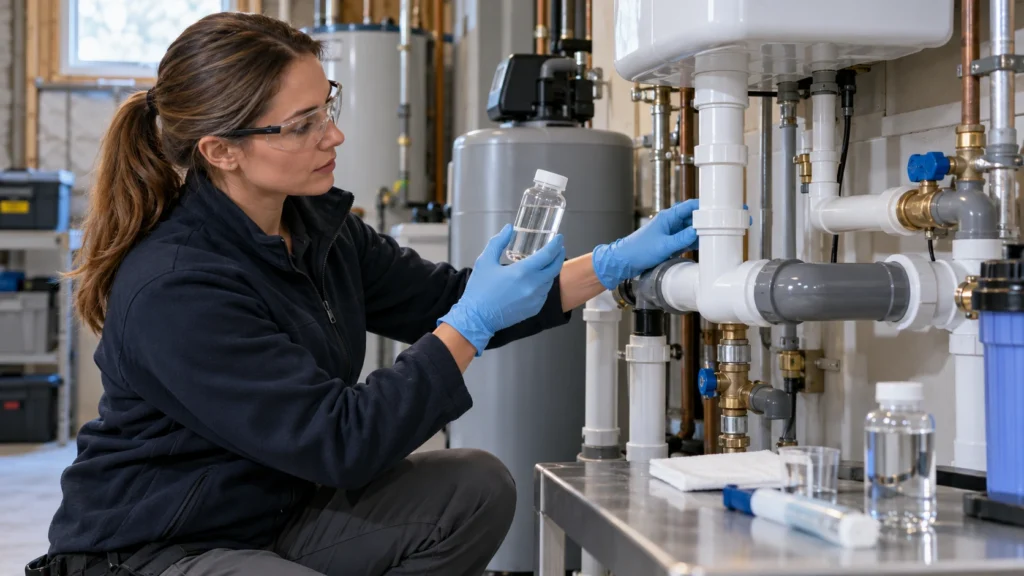
Blue-green stains around a drain, a pinhole leak in a copper line, or white crust on a faucet can all make you wonder whether your water is attacking your plumbing.
The Langelier Saturation Index, or LSI, helps answer that question by estimating whether water is undersaturated or oversaturated with calcium carbonate. That gives you an indication of whether the water tends toward corrosion, balance, or scale formation.
ETR Laboratories offers a Langelier Corrosion Index test. This guide explains what goes into the score, how to read it, what negative and positive results can mean, and when additional testing for metals such as lead or copper may make sense.
The Langelier Saturation Index predicts whether water is likely to dissolve calcium carbonate, remain near equilibrium, or deposit calcium carbonate as scale. A negative score indicates undersaturation and greater corrosion potential, a result near zero indicates balance, and a positive score indicates greater scale-forming potential.
The basic relationship is:
LSI = pH – pHs
Here, pH is the water’s measured pH, while pHs is the theoretical saturation pH at which calcium carbonate is in equilibrium.
UGA Extension describes the index as a comparison between the actual pH of water and its theoretical saturation pH.
A simple way to think about saturation is sugar in tea. Water can hold only so much dissolved material under a given set of conditions. When calcium carbonate is undersaturated, the water has greater potential to dissolve mineral material. When it is oversaturated, calcium carbonate is more likely to deposit as scale.
MSU Extension similarly notes that water undersaturated with calcium carbonate has greater corrosion potential, while oversaturated water tends toward scale.
Extension sources describe five main inputs: pH, alkalinity, hardness, total dissolved solids, and temperature.
| Input | What It Tells the Calculation | ETR Option |
| pH | How acidic or basic the water is | pH water test, $35 |
| Alkalinity | How strongly the water resists changes in pH | Alkalinity water test, $40 |
| Hardness | Helps describe the calcium carbonate balance | Water hardness test, $65 |
| Total dissolved solids | Reflects the concentration of dissolved minerals and salts | Included as an input in the LSI calculation |
| Temperature | Affects calcium carbonate saturation | Used as an input in the LSI calculation |
ETR’s pH product page says water should ideally fall between 7.0 and 8.5 SU and notes that acidic water can contribute to corrosion. Our article on the best pH level for drinking water covers pH in more detail.
ETR’s alkalinity page gives 20 to 200 mg/L as calcium carbonate as a generally recommended range and connects low alkalinity with corrosion and high alkalinity with scale.
Hardness comes from calcium and magnesium in water. Our guide to the types of water hardness explains those measurements.
The LSI calculation brings these measurements together to estimate calcium carbonate saturation. Hardness is part of that balance, alongside pH, alkalinity, TDS, and temperature. If you already have recent results for some of these parameters, call us and we can tell you whether they can be used with your Langelier test.
In general:
MSU Extension publishes the following interpretation bands:
| Score | Description | General Guidance From MSU Extension |
| -4 | Severe corrosion | Treatment recommended; consider lead/copper testing |
| -3 | Moderate corrosion | Treatment recommended; consider lead/copper testing |
| -2 | Moderate corrosion | Treatment may be needed; consider lead/copper testing |
| -1 | Mild corrosion | Treatment may be needed; consider lead/copper testing |
| -0.5 | None to mild corrosion | Probably no treatment |
| 0 | Near balanced | No treatment |
| 0.5 | Some faint coating | Probably no treatment |
| 1 | Mild scale coating | Treatment may be needed |
| 2 | Mild to moderate coating | Treatment may be needed |
| 3 | Moderate scale forming | Treatment advisable |
| 4 | Severe scale forming | Treatment advisable |
These are guidelines rather than universal cutoffs. MSU Extension’s corrosivity fact sheet uses the bands above, while UGA Extension treats scores between about -1 and +1 as having little corrosive or scale-forming effect.
That difference is one reason not to overread a small change around zero.
A slightly positive score is not automatically a problem. A thin calcium carbonate coating can sometimes help protect metal plumbing from direct contact with the water.
If you want your own number, ETR’s Langelier corrosion index test costs $100.
A negative LSI indicates greater corrosion potential. That does not prove your plumbing is already corroding, but it can raise concern when combined with older pipes, visible staining, leaks, or other water-quality findings.
Possible signs of corrosive water include:
MSU Extension notes that corrosive water can mobilize lead and copper from plumbing into drinking water.
That is why a clearly negative result can be a reason to consider testing for lead and copper. It is especially relevant when the LSI is around -1 or lower under MSU’s guidance.
A negative LSI is not proof that either metal is present.
ETR’s lead water test costs $45. The first-draw and flush lead and copper test costs $100 and compares water that has sat in the plumbing with a later flushed sample.
Our guides on whether lead pipes are contaminating your water and how to test for lead with the first-draw method explain those next steps.
A positive LSI indicates greater potential for calcium carbonate scale.
Scale can build up in water heaters, plumbing, appliances, and fixtures. UGA Extension identifies the water heater as a common place for buildup and notes that heavy scale can reduce efficiency or restrict water flow.
Scale is closely related to hardness, but the two are not identical. Hardness is only one of the inputs used to estimate calcium carbonate saturation.
Our article on how hard water affects appliances covers those effects in more detail.
A positive LSI does not mean the water is unsafe to drink. The main concern is usually scaling and equipment performance.
LSI is useful, but it has limits.
If your home has older plumbing, lead and copper testing may still be worth considering even when the LSI is near zero because the index does not directly measure those metals.
The practical route is to have a laboratory calculate the result from measured water-quality inputs.
ETR’s Langelier corrosion index test costs $100 and indicates whether your water tends toward corrosive or scale-forming conditions.
Our guide to collecting a water sample explains general collection practices, including using the appropriate tap and following the kit instructions.
If you already have recent pH, alkalinity, hardness, or other chemistry results, call ETR at (800) 344-9977 and ask whether those measurements can be used when evaluating your Langelier result.
The next step depends on the direction of the score.
ETR focuses on testing rather than treatment equipment. A qualified plumbing or water-treatment professional can assess what changes, if any, make sense once the water chemistry is known.
For a broader look at your water, our panel guide compares the Basic, Premium, and Ultimate testing options.
A result near zero is generally considered balanced. MSU Extension labels zero as near balanced, while UGA Extension treats a broader range around zero as having little corrosion or scale-forming effect. There is no single perfect LSI target for every home, so read the score alongside your plumbing and water chemistry.
A negative LSI means the water is undersaturated with calcium carbonate and has greater corrosion potential. It does not prove that pipes are corroding or that lead or copper is present. MSU Extension recommends considering lead and copper testing at scores around -1 and lower.
Yes. The calculation uses pH, saturation pH, and water-quality inputs such as alkalinity, hardness, total dissolved solids, and temperature. The challenge is getting accurate input values. A laboratory test is the more dependable route if you plan to use the result to make plumbing or treatment decisions.
No. Hardness is one factor that contributes to scale potential, but pH, alkalinity, total dissolved solids, and temperature also affect the LSI. Hard water may leave mineral deposits, while the Langelier Index looks at how several conditions combine to influence calcium carbonate saturation.
ETR Laboratories can calculate your water’s corrosion-versus-scale tendency with the $100 Langelier corrosion index test.
If the result is clearly negative, or your home has older plumbing, you may also want to consider a lead water test rather than assuming the index alone tells you whether metals are present.
You can compare broader testing options in our panel guide or contact us if you want help deciding what to test.