Unknown Residue in Water? FTIR, SEM and Microanalysis
Black flakes in the sink, orange crust around a faucet,

Black flakes in the sink, orange crust around a faucet, or a slimy film in the toilet tank can leave you wondering what you are looking at. Unknown residue in water often has a simple explanation that a standard water test can identify, such as hard water minerals, iron, or manganese.
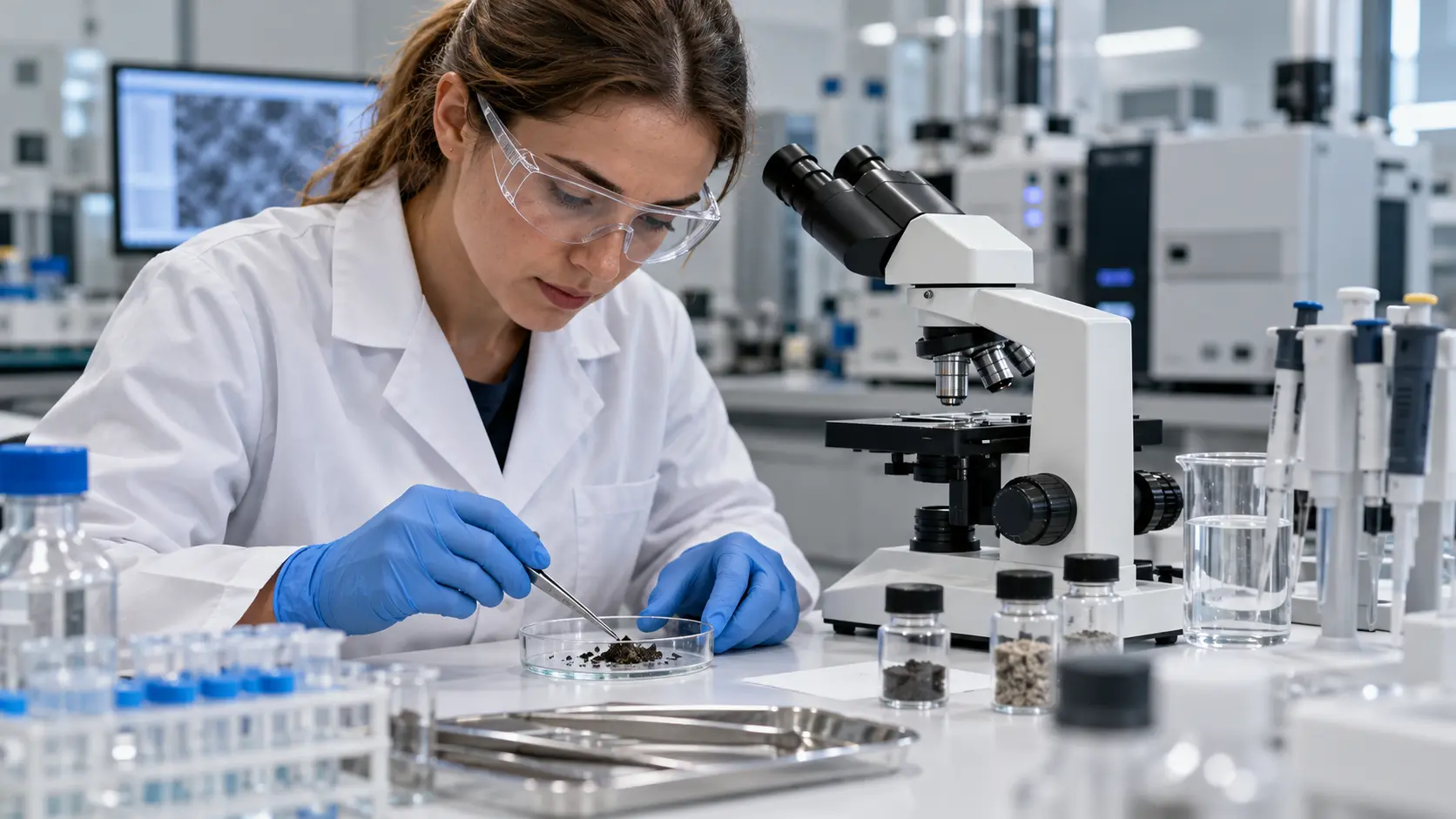
When a standard test cannot name the material, a laboratory can look at the residue itself using FTIR, SEM with EDS, or microanalysis. ETR Laboratories offers all three, and each answers a different question. If you are dealing with cloudy or gritty water rather than a collectable residue, our guide to how sediment gets into well water covers the more common causes.
The color and texture of a residue can point toward a likely cause, but they do not prove it. Looking at the basic clues first can keep you from ordering advanced analysis when a standard water test would answer the question.
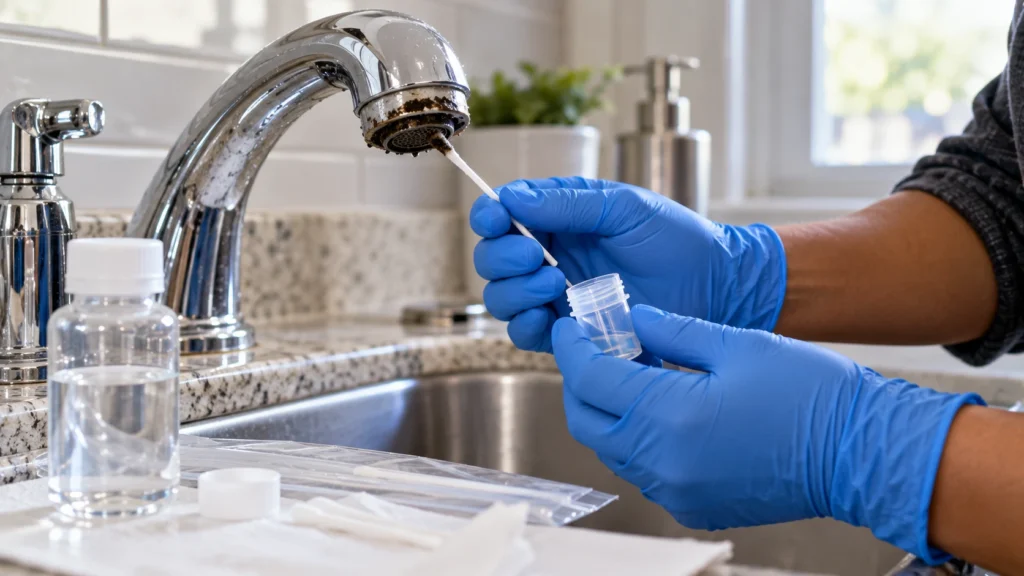
The EPA associates iron with rusty colors, sediment, and reddish or orange staining, while manganese is associated with black to brown color and black staining in its secondary drinking water standards guidance.
Common clues include:
Our guide to what each water color means goes through those clues in more detail.

A routine water test is often the better first step when the residue appears to come from dissolved minerals or general water chemistry.
Depending on the question, that may include hardness, iron, manganese, pH, alkalinity, total dissolved solids, and turbidity. These measurements can help explain common staining, scale, cloudiness, and mineral buildup without requiring a more expensive identification method.
Our Water Hardness Test costs $65, while the Iron Water Test and Manganese Water Test cost $45 each.
If the water is cloudy but you cannot collect visible particles, a $40 turbidity test measures the particles suspended in the water. Our guide to turbidity in water explains how to interpret that result.
More specialized analysis becomes useful when:
FTIR can also be used for certain types of plastic identification, which is why the method appears in discussions of microplastics in drinking water. That does not mean every FTIR service is automatically a microplastics test, so the method should match the actual question.
FTIR stands for Fourier Transform Infrared Spectroscopy. It scans a sample with infrared light and measures how the material absorbs that light at different wavelengths.
The resulting pattern acts like a molecular fingerprint. Laboratories can compare that pattern with reference libraries to help identify organic, polymeric, and, in some cases, inorganic materials.
In practical terms, FTIR water analysis can help answer questions such as:
Northwestern University’s facility describes FTIR as a technique used to “study chemical bonding and identify molecular structures”.
FTIR is generally an identification method rather than a precise elemental measurement. It does not tell you which individual elements make up a particle the way EDS does.
ETR’s FTIR test currently costs $265.
SEM, or scanning electron microscopy, creates high-resolution images of a solid particle. EDS, or energy-dispersive X-ray spectroscopy, is used alongside SEM to report which elements are present in that material.
The University of Wisconsin’s microscopy facility describes EDS as a method for determining elemental composition and notes that results are generally qualitative or semi-quantitative.
That makes SEM water analysis with EDS useful when the question is not only what a particle looks like, but what elements it contains.
ETR’s SEM service lists applications including:
The report includes high-resolution SEM images, elemental composition results, and interpretation.
SEM with EDS reports elements rather than molecular identity. If you need to determine whether a flake is a polymer, resin, or organic material, FTIR may be the better fit.
ETR’s SEM analysis with EDS currently costs $325.
A water microanalysis test is designed for a different type of question: whether microorganisms are present and what they are.
ETR’s microanalysis test uses scanning electron microscopy and nuclear magnetic resonance to identify the genus and species of bacteria, fungi, and other microorganisms in a water sample and quantify them.
The current listed price is $495, and ETR asks customers to allow 7 to 10 days for the testing to be completed.
The product page suggests considering this type of analysis in situations such as unexplained illness in a household or when a baby will soon be added to the home. The test itself cannot diagnose an illness, so medical concerns should still be discussed with a physician.
A routine bacteria test is usually the lower-cost first step. ETR’s coliform and E. coli test costs $65 and looks for common bacterial indicators. Microanalysis goes further by identifying specific microorganisms.

A simple way to narrow it down is:
| Test | What it identifies | Best for | What it does not tell you | Price |
| FTIR | Organic, polymeric, and some inorganic materials | Flakes, films, resins, plastics | Elemental composition | $265 |
| SEM with EDS | Particle appearance and elemental composition | Mineral, metal, corrosion, sediment, and scale | Molecular identity | $325 |
| Microanalysis | Genus and species of bacteria, fungi, and other microorganisms, with quantities | Suspected microorganisms in water | What an unrelated solid particle is made of | $495 |
Not sure which one fits? Call ETR at 800-344-9977, describe what you found, and send a photo if you have one. The lab can help determine which analysis is appropriate before you order.
The exact container, sample amount, and shipping requirements can depend on the analysis, so contact ETR before sending an FTIR, SEM, or microanalysis sample.
For a visible residue or solid:
Do not add chemicals or cleaning products to the material. Do not rinse, scrub, or intentionally dry it, and do not combine residues collected from different places unless the lab tells you to.
The purpose of identification is to narrow down where the material may be coming from.
A result may point toward plumbing components, filter media, a well casing, biological material, corrosion, or naturally occurring minerals. From there, a plumber, well contractor, or other licensed professional can investigate the source and decide whether a repair or treatment is appropriate.
ETR provides testing and laboratory results rather than treatment equipment.
If the result points toward sediment, our guide to the signs you need a sediment filter provides general background before you speak with a professional.
A baseline chemistry panel may also help put the residue into context by showing what is present in the water itself.
FTIR identifies a material using its molecular fingerprint. SEM creates detailed images of a particle, while EDS reports which elements are present. The methods answer different questions, so laboratories may use both when one type of analysis does not provide enough information.
Often, yes. Black sediment in well water can come from manganese, filter media, rubber components, or other materials. A routine water panel can help identify dissolved minerals, while a sample of the solid can be examined with a method such as SEM with EDS when the source is still unclear.
It is usually worth checking hardness first because limescale is a common cause of white crust on fixtures. ETR’s $65 hardness test measures water hardness directly, and our guide to white residue on fixtures explains the connection.
ETR’s microanalysis product page says to allow 7 to 10 days for testing to be completed. If timing matters for your situation, contact the lab before sending the sample.
If you have an unknown residue, start by deciding whether a routine water test may already answer the question. If you have a collectible solid or suspected microorganism that still needs identification, FTIR, SEM with EDS, or microanalysis may be the better next step.
Describe the residue and use the table above to narrow down the method, then contact ETR Laboratories at 800-344-9977 before sending the sample if you are unsure about collection or submission requirements.
For a broader look at the chemistry of the water itself, our panel guide can help you compare the available testing options.