
Well Water Testing for a Mortgage Refinance: What to Expect
You have found a better rate, your home runs on
Free Shipping on Orders of $100 or More
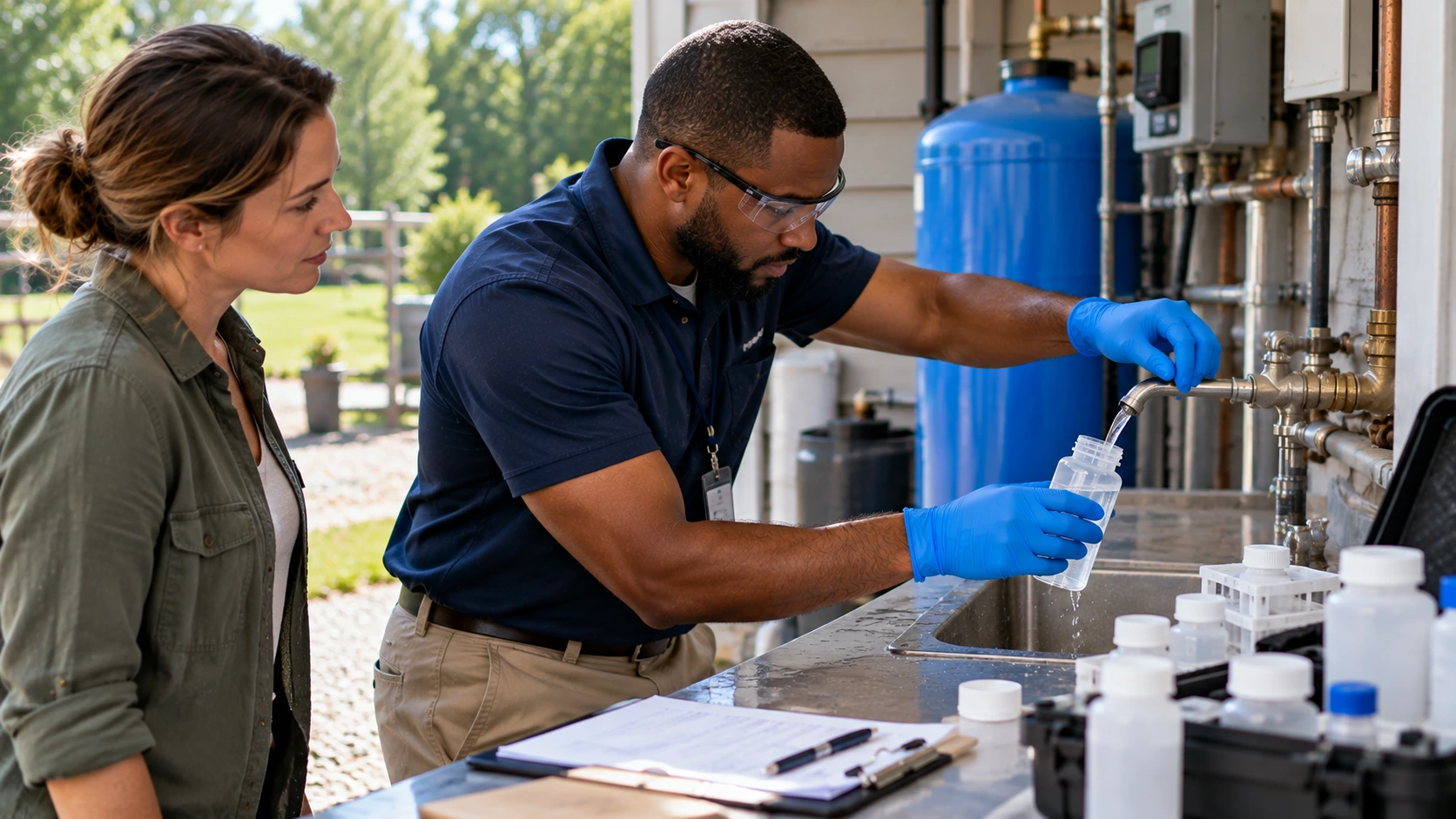
You have found a better rate, your home runs on a private well, and nobody has said whether the lender will ask for a water test. The short answer is that it depends on the lender, the loan program and whether an appraisal is involved, so a well water test for refinance purposes is required in some cases and never mentioned in others.
A refinance has no seller, so you order and pay for the test if one is requested. At ETR Laboratories, we test well water for homeowners in that position, and the most useful advice we can give is to get the lender’s requirements in writing before you order anything. Panels, sample validity and the sale-side rules are covered in well water testing when buying or selling a home, so we keep those details short here.
In this article, we cover which refinances tend to trigger a test, what appraisers and underwriters do with a private well, what to ask your lender, how to time the test around a rate lock, and what happens if the water fails.
A well water test for a refinance works differently from one for a purchase, since there is no purchase contract, no seller to share the cost or offer a credit, and no contingency window built around inspections. You own the home, so only you can order the test, while the lender decides what it covers.
Lenders still look at the water, and some lenders and insurance companies require proof of safe drinking water before approving mortgages or policies.
With a rate lock rather than a closing date driving your timeline, the type of refinance you choose shapes what happens next.
It depends on the lender, the loan program and whether the loan involves an appraisal. Streamlined programs that skip a new appraisal make a test less likely, while appraisal-based and cash-out loans put the well in front of an appraiser and underwriter. We found no verified rule that makes a test automatic on a conventional refinance, so when you ask whether a refinance requires a well water test, your lender decides.
The table sorts common refinance types by how likely a test is.
| Refinance type | Is an appraisal usual? | How likely is a test? | Basis |
| FHA streamline | Often skipped; confirm with lender | Less likely; lender conditions apply | Secondary sources only |
| VA IRRRL | Often skipped; confirm with lender | Not addressed by the VA; ask | VA page silent on both |
| USDA streamlined and streamlined-assist | No new appraisal required | Less likely; lender judges water system | 7 CFR 3555.101 and 3555.201 |
| Standard rate-and-term with an appraisal | Usually | Possible; lender decides | Lender and appraiser discretion |
| Cash-out | Usually | Possible; no verified rule | Lender and appraiser discretion |
USDA gives the clearest written rule. Under 7 CFR 3555.101, lenders may offer a streamlined refinance that does not require a new appraisal, and streamlined-assist has no appraisal requirement except for subsidized Section 502 direct borrowers.
For an FHA streamline refinance, the no-appraisal point comes from secondary sources and we could not read the HUD handbook text, so confirm it with your lender. The VA’s IRRRL page explains that this streamline refinance can lower your rate or move you to a fixed rate, but it says nothing about appraisals or water testing.
Cash-out and standard rate-and-term loans usually include an appraisal, so a cash-out refinance well water test request is plausible there.
They confirm the well is an available water source that meets community standards, and they note anything that could affect the home’s value. Under Fannie Mae’s site requirements for the appraisal, a property’s utilities must meet community standards, and when public water is not available a private well must be available and in use. If a hazard affects the water, the appraisal must address its effect on value and marketability.
Fannie Mae’s environmental hazards guidance goes further. When a lender has reason to believe private well water might be contaminated because the well sits near hazardous waste sites, the lender is exercising sound judgment if it obtains a “well certification” to determine whether the water meets community standards.
No appraisal doesn’t mean no property review. A lender can add conditions to any loan, and a past water problem, a nearby hazard, or a local rule can each lead to a test request even when the program skips the appraisal. Those conditions come from your lender, so ask for them directly.
Ask for the requirement in writing before you order anything, since details vary by lender and loan program and a generic well panel can lead to duplicate testing. Here are the questions to ask your lender:
Since lenders set these details, we do not claim that any single test automatically satisfies a refinance requirement. The lender’s written answer is what you order against.
The lender or county health department sets the parameter list for well water testing on a refinance. Our FHA Water Test covers a typical FHA-style set, and here are the parameters on its product page:
The EPA recommends that private well owners test annually for total coliform bacteria, nitrates, total dissolved solids and pH. For bigger panels, choosing between basic, premium and ultimate walks through the differences, and our guide on well water testing costs covers pricing.
Ask your lender for the required parameters in writing, then order the FHA Water Test if the list matches. With the list settled, timing is the next concern.
Timing Your Well Test Around Your Rate Lock
Order the test as soon as your lender names the requirement. Bacteria samples need incubation time after they reach the laboratory, which sets a floor on how fast a result can arrive. Rate lock terms are lender-specific, so we cannot give numbers for yours, and we would rather confirm timing by phone than quote a general turnaround.
Sale-side rules commonly cite a 30- to 90-day window before closing, and the lender sets the actual window. Refinance lenders may differ, so ask for the deadline in writing. Here is a sensible order if you refinance with a well water test on the checklist:
Payment and collection come next when there is no seller.
You do. With no seller or purchase contract, the homeowner orders and pays for the test. The lender can still shape the requirement, since it may set the parameter list and the collector regardless of who writes the check.
Lenders differ on whether an independent collector is required. Chain-of-custody documentation provides a traceable record of who handled the sample, which is why a lender may want someone other than you to hold the bottle.
We send reports only to the people you designate, such as a financial institution, and real estate transaction testing comes with a private consultation with our staff at no additional charge. If a result comes back with a problem, the next steps are yours alone.
A failed result means you identify what failed, fix it, retest and send the new result to your lender. For a bacteria failure, the sale-side article puts the full sequence at about three weeks. Here is how it usually runs:
Sampling too soon is the classic error, since residual chlorine suppresses bacterial growth and can produce a clean result that does not hold. For a nitrate or lead failure, the fix depends on the source, and what to test for and how often is a useful read.
With no seller, there is no credit or price negotiation to fall back on, and escrow or repair conditions are up to the lender.
Here are short answers to common questions.
Usually not on the program’s own terms, because FHA streamlines generally skip a new appraisal. That comes from secondary sources, though, and your lender’s own conditions still apply. Ask your lender in writing before you pay for a test, and confirm the HUD text.
The VA’s IRRRL page does not address water testing or appraisals, so ask your lender. A 2020 pandemic-era circular waived well testing for VA-to-VA refinances “until further notice,” and it should not be treated as current policy. Ask for the present rule.
Yes. Lenders can add conditions, and Fannie Mae’s guide lets a lender obtain a well certification when it has reason to suspect contamination. That judgment can apply even when a program skips the appraisal. For USDA loans, the lender determines whether a private water system is adequate and safe.
Lenders often accept results for a set window, commonly cited as 30 to 90 days before closing. The lender sets the actual window, and some require collection within 30 days, so confirm it first.
Possibly. A lender may accept an existing result if it includes every required analyte, meets laboratory and collection requirements, and falls inside the lender’s age window. Treat 30 to 90 days as a commonly cited range, and confirm the actual period first.
Sometimes. Some transactions may accept homeowner collection, while others require an independent collector, laboratory representative, health official or another approved third party to document how the sample was taken. Confirm the requirement before you open the kit, since the wrong collector can mean paying twice.
Not automatically, based on the sources we reviewed. Conventional lenders can set property conditions and may ask for well documentation when an appraisal, suspected contamination, local requirements or underwriting concerns raise questions about the water supply. Ask your lender rather than assuming either way.
Once your lender has confirmed the parameters, the collector and the deadline in writing, you can order our FHA Water Test for $80. Its product page describes the test for home purchases, so check with your lender before relying on it for a refinance.
If you are unsure how the pieces fit together, call ETR Laboratories at (800) 344-9977 with your closing date and what your lender asked for, and we will talk through the timing with you.
You have found a better rate, your home runs on
If you run a school or child care facility and
Water collected at your tap or well can travel across
Related Post.
Well Water Testing for a Mortgage Refinance: What to Expect
You have found a better rate, your home runs on a private well, and nobody
EPA’s 3Ts Program: Lead Testing for Schools and Daycares
If you run a school or child care facility and go looking for guidance on
Mail-In Water Testing: How It Works Anywhere in the US
Water collected at your tap or well can travel across the country to a laboratory
Chromium 6 Water Test: The Test With No Federal Limit
Your well report says chromium is under the limit, and that may seem like the
How VOCs Are Tested in Well Water: Lab Method Explained
A VOC kit arrives with small glass vials, a preservative already inside, a no-bubble rule
Copper and Manganese: Why Some Water Tests Skip Them
You open a water test report, or compare two test kits side by side, and
Golf Course Pesticides and Your Well Water: What to Test
Field studies have found turf pesticides in some groundwater beneath golf courses, usually below health
Giardia and Cryptosporidium in Well Water: Can You Test?
After a stomach illness, a flood, or a neighbor’s warning about parasites, a passing bacteria
Uranium Water Test: The Well Test Most Owners Skip
Uranium has no color, taste, or smell, and the routine tests many well owners order
State Well Water Testing Requirements by Region: A Guide
Private well testing requirements vary by state, and your county or municipality may add rules
Inside the ETR Laboratory: How Samples Are Analyzed
Most people who order a water test never see what happens after they mail the
Home Water Filtration Systems Often Pay for Themselves. Here Is the Math.
From the Lab by ETR Laboratories Most people treat bottled water as a small household