City Water vs Well Water: Different Tests, Different Risks
City water and private well water are managed differently, so
Free Shipping on Orders of $100 or More
You searched for a well water testing lab nearby and found nothing. Maybe nothing was close, or the labs you found didn’t serve homeowners. Well water testing with no local lab still leaves you several practical ways to get your water analyzed.
A laboratory doesn’t have to be down the road to be useful. Some state and county programs offer testing or help residents find qualified labs, and many laboratories accept properly collected samples by shipment when the analysis allows it.
Distance is the least important part of the decision. What counts is a lab that runs the analyses you need, accepts your type of sample, and meets any credential requirements for your purpose. It also has to receive the sample within the holding time for that test. This guide from ETR Laboratories walks through each option and explains what changes when a lender or permit authority has to accept the result.
Four points shape your options when no lab is nearby:
A local search sounds like the obvious first step, but proximity solves only part of the problem. Not every lab in a local search performs drinking water analysis. Some focus on industrial, wastewater, soil, or commercial work. Others test drinking water but:
Search results also blur the line between labs and sellers. A company can rank for a local search without running a lab in your area, or any lab at all, if it forwards samples to a partner facility. A nearby lab isn’t automatically the right one, and a distant lab isn’t automatically the wrong one. A lab an hour away might run coliform bacteria and nitrate but skip arsenic or PFAS. A lab several states away that accepts shipped residential samples could be the more useful choice, and with an overnight courier it can sometimes return results sooner than a local lab that batches its work weekly.
If you’re still checking for nearby providers, our guide to water testing nearby explains how to find a lab and confirm its credentials and testing scope fit what you need.
Start with the government resources already serving your area. Depending on where you live, your state drinking water agency, environmental department, or county health department may:
Services vary widely, so don’t assume every state or county offers free testing, low-cost testing, or the same contaminant list. Where a county does test, the menu is often narrow. A county bacteria test may cost nothing or only a few dollars, but metals, organic compounds, and PFAS usually require a private lab. A county program can still be a smart first step for well water testing with no local lab, since staff often know which contaminants turn up in your area and which labs other residents use. One county might run an occasional bacteria program and refer residents elsewhere for metals. Another might not test at all but keep a list of labs that do.
Contact your state environmental or health agency and the local health department serving your address, and ask:
Drinking water lab certification runs state by state, and the EPA keeps contact information for each state’s certification program so you can find your state’s list of certified labs. If your county doesn’t test the parameters you need or has no residential program, move to the next option.
A suitable lab doesn’t need to be physically nearby if it accepts properly collected shipped samples. The key is verifying the lab before you collect anything. Confirm that it:
Credentials carry the most weight when another organization will rely on the result. A homeowner testing for personal information usually has more flexibility than someone testing for a sale or permit.
When the best-fit option turns out to be a certified lab far away, distance on its own shouldn’t rule it out. Ask if it accepts shipped samples, and compare it on the same terms as a local lab. Our guide to choosing the right water testing lab covers what to compare beyond location, including testing scope, turnaround, and reporting.
A mail-in service packages collection and shipping into one convenient order. The service typically sends you:
You collect the sample by following the instructions, then send it back for analysis. Our walkthrough of how a mail-in well water test works covers the full process, from kit arrival through reporting.
“Mail-in” describes how the sample reaches a laboratory. It says nothing about the quality of that laboratory. Some mail-in brands forward samples to a partner lab, while others are labs that ship their own kits directly. In either case, find out which laboratory performs the analysis and check that its credentials apply to the testing you need. A few questions help you compare mail-in services on more than price:
Turnaround through a brand that forwards samples to a partner lab can run a little longer, since the sample and the report pass through one extra set of hands. Ordering directly from the lab that runs the analysis keeps the sample and its paperwork under one roof, along with the people you talk to about results. Our comparison of lab testing and mail-order water test kits covers the differences between those two models.
No. Shipping suitability depends on the analysis, and some samples carry specific requirements for:
Bacteria samples carry the shortest clock of anything on a routine panel, so a sample meant for microbiological analysis may need to reach the lab much faster than some chemistry samples. The exact window depends on the method and the lab. Don’t assume one shipping schedule fits every bacteria, metals, PFAS, or chemistry test.
Contact the lab before you collect and ask:
Collecting first and asking later can leave you with a sample the lab can’t use.
Convenience stops being the main consideration when someone else has to accept the result. That could be a lender, health department, regulator, permit authority, buyer, or local government. Before you order any kit, ask that organization:
A lender or regulator may set its own analytes, lab credentials, collection rules, or documentation. When you collect your own sample and mail it in, the lab reports what arrived. That result is useful for your own decisions, but it carries no outside proof of who drew the water or where, which is why many transactions call for a documented chain of custody handled by a trained collector.
Timing is a factor here too. Many lenders want results from a recent sample, so collecting too early can mean testing twice before closing. Ask how recent the result must be and plan your collection date backward from the deadline. Ordering a general kit first can mean paying for a test you’ll have to repeat. For routine monitoring, you can usually choose a suitable lab and collect the sample yourself. For compliance or transaction testing, the requesting party’s rules come first.
The options above aren’t ranked by quality. The right one depends on the job, and the table below matches common situations to a starting point.
| Situation | Where to Start | Can Shipping Work? | What to Verify |
| Routine well monitoring | State or county program, or a qualified mail-in lab | Often | Parameters, lab credentials, collection and holding-time requirements |
| Specific contaminant concern | A lab that performs that exact analysis | Often, if handling requirements can be met | Testing scope, method, sample requirements |
| No local residential lab | A distant lab or mail-in service | Often | Residential intake, containers, turnaround, applicable credentials |
| Real estate transaction | Lender and local health department requirements | Sometimes | Required analytes, approved lab, collection rules, chain of custody |
| Regulatory testing | Requesting agency or its approved lab | Depends on the agency | Required method, credentials, documentation, collector rules |
| Time-sensitive bacteria testing | A lab that can receive the sample inside the required window | Sometimes | Holding time, temperature, delivery schedule |
No suitable local lab? If your analysis can be shipped, compare our well water testing options and confirm the collection and timing requirements for your purpose before you collect a sample.
Requirements differ by analysis, so follow the instructions for the test you ordered in place of a generic shipping routine. A few principles apply across the board:
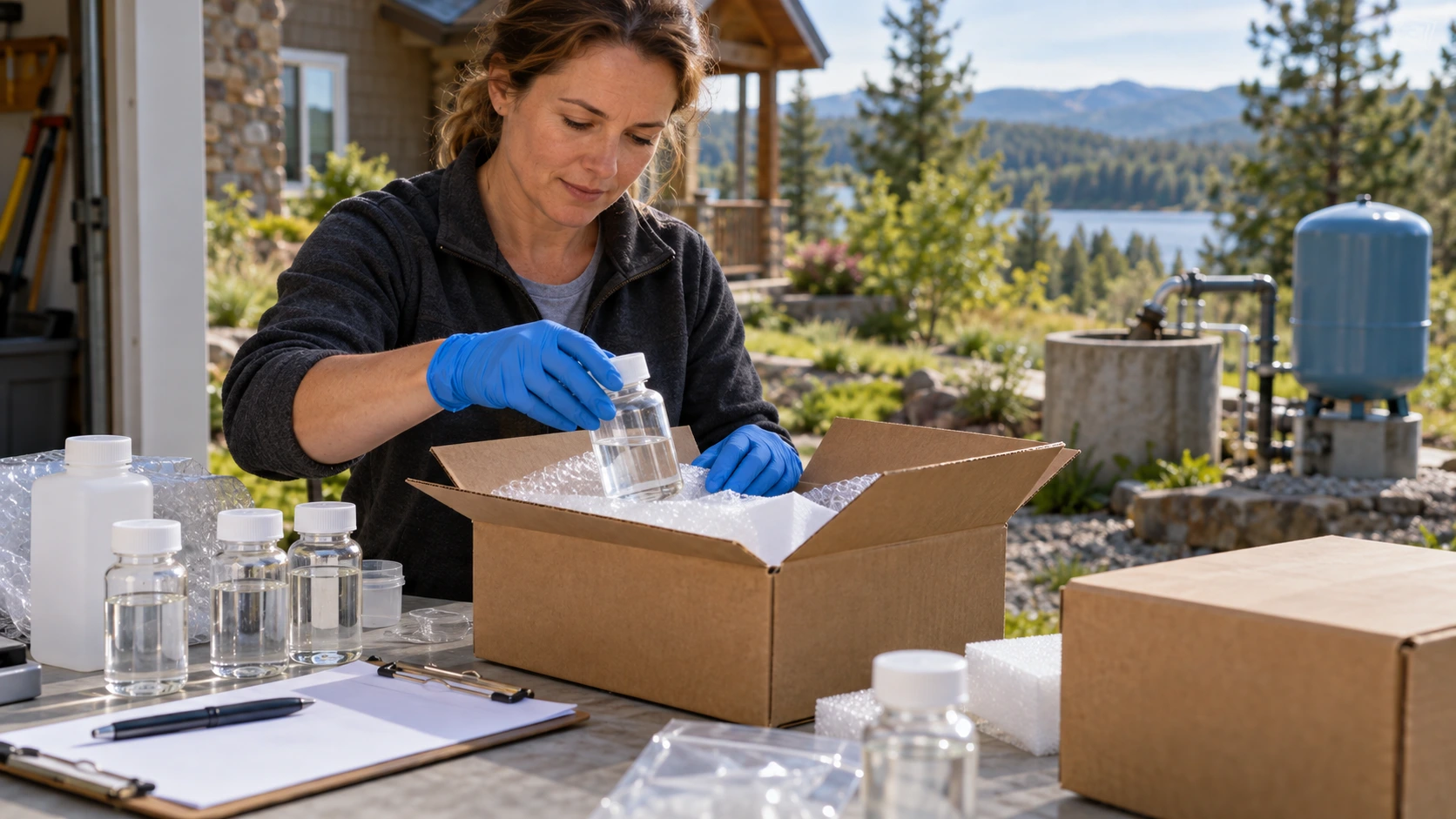
Before collecting anything time-sensitive, ask the lab which days it recommends for shipping. As a general rule, collect and ship on the same day, early in the week, and use the overnight or second-day service the lab specifies for remote samples. Pack the bottles upright and sealed, and keep the completed sample form in the box so the lab can match your sample to your order on arrival.
Once the sample arrives, the lab checks that the right containers were used and the holding time was met, along with temperature, paperwork, and sample volume. If something doesn’t pass, a good lab will contact you or request a new sample before it will report a result from an unsuitable one. Turnaround can also vary within a single panel, so ask if results are released as they’re ready or only once the full panel is complete.
The delivery method alone doesn’t determine analytical quality. A properly collected and handled sample can be shipped and analyzed with the same lab methods that apply to a sample delivered in person. The deciding factor is the condition of the sample when it reaches the lab, which has to meet its collection, preservation, temperature, and holding-time requirements. If your purpose requires a particular credential, verify that separately.
A government program is only one route. Look for a qualified laboratory that accepts shipped residential samples, or a mail-in service whose lab and credentials you can verify. Well water testing with no local lab and no county program still doesn’t leave you limited to home test strips. Strips and meters can flag a pH or hardness issue, but they can’t measure contaminants such as arsenic or PFAS at the low levels a laboratory can, so a shipped lab sample remains the stronger option.
Often, yes, for informational household testing. Collection rules depend on both the analysis and the intended use of the result, though. A lender, regulator, or permit authority may require specific collection procedures or specify who can collect the sample, so confirm those rules before you collect.
Having no local lab doesn’t have to stop you from testing your well. ETR Laboratories ships well water testing kits nationwide. Each kit includes the bottles and collection instructions your test needs, plus a prepaid return shipping label, and our own scientists run the analysis in our Leominster, Massachusetts lab once the sample arrives.
If you’re unsure if a particular analysis can be shipped, or if the result has to satisfy a lender or regulator, confirm those requirements before you collect. For routine or informational testing that works by mail, compare ETR’s well water testing options and choose the panel that answers your question.
City water and private well water are managed differently, so
When your ETR Lab’s water test kit arrives, the first
Water testing ads usually talk about the kit in your
Related Post.
City Water vs Well Water: Different Tests, Different Risks
City water and private well water are managed differently, so the reasons you may want
What Comes in an ETR Water Test Kit: A Full Breakdown
When your ETR Lab’s water test kit arrives, the first question is usually simple: what’s
How ETR Laboratories Tests Your Water, Step by Step
Water testing ads usually talk about the kit in your mailbox. The part that decides
Water Test Panel Guide: Basic, Premium, or Ultimate?
Ordering a water test sounds simple until you see the options. One lab sells Basic,
How to Get Your Well Tested Without a Local Lab Nearby
You searched for a well water testing lab nearby and found nothing. Maybe nothing was
Michigan Well Water Testing Requirements: What to Know
Michigan requires testing when a private residential well is constructed, and state guidance calls for
Why Free Water Tests From Softener Companies Are Not Free
A free test a salesperson performs in your kitchen is a sales demonstration. It differs
12 Questions to Ask Before You Pay for a Water Test
Search for advice on what to ask before hiring a water company, and most of
Water Filters That Actually Remove PFAS: A Lab Guide
Every filter box on the shelf claims to handle PFAS these days, but that claim
Legionella Testing for Building Water Systems: A Full Guide
Everyone expects you to already have a water management program running. An outbreak would end
ASHRAE 188 Compliance: What Water Testing Is Required
Standard 188 doesn’t tell you to test for Legionella every three months. It doesn’t hand
Do You Have a Lead Service Line? 10 Ways to Check
A notice from your water utility landed in the mail. It lists your pipe material