Chromium 6 Water Test: The Test With No Federal Limit
Your well report says chromium is under the limit, and

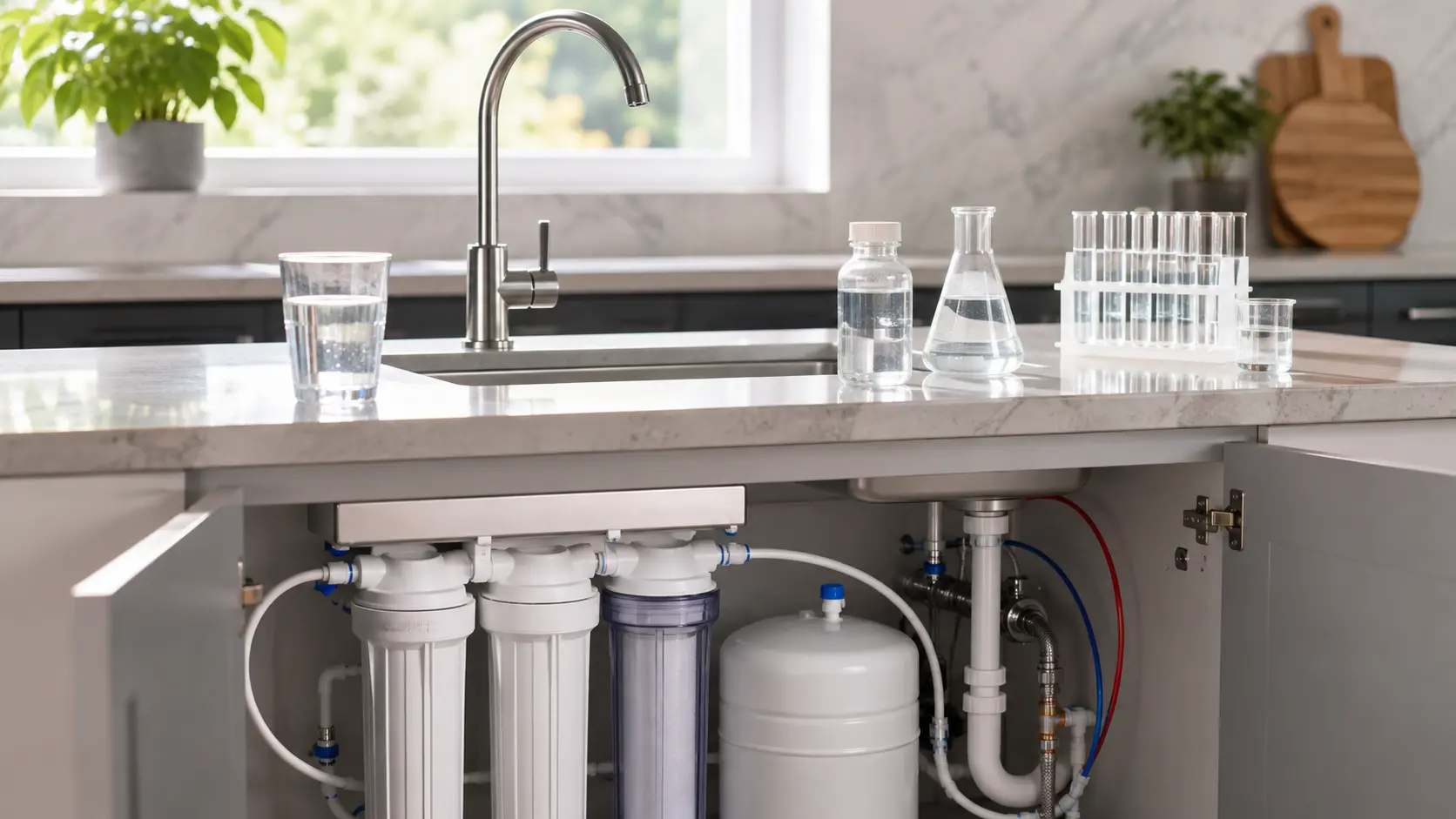
Every filter box on the shelf claims to handle PFAS these days, but that claim is only worth as much as the technology and testing behind it. Three treatment approaches actually carry real evidence: activated carbon, anion exchange resin, and reverse osmosis. Each works within limits, and each handles some PFAS compounds better than others. The box tells you what the manufacturer claims. A sample of your treated water tells you what’s actually true. This guide walks through how to read those claims and how to confirm them for yourself.
PFAS molecules are built around carbon-fluorine bonds, among the strongest bonds in organic chemistry. Heat, chlorine, and sunlight leave them intact, which is where the forever chemicals nickname started. Boiling actually makes matters worse. Water leaves as steam, and the PFAS stays behind in a smaller volume, so the concentration rises. Household treatment works by capturing these molecules or straining them out, never by breaking them apart at the tap. Our broader look at protecting your family from PFAS covers the exposure side of this if you’re starting from scratch.
PFAS covers thousands of compounds, and they do not behave alike. Longer-chain compounds such as PFOA and PFOS attach to activated carbon readily, so carbon systems handle them well. Shorter-chain compounds are smaller and less inclined to adsorb, so they move through the same media sooner. That difference shapes which technology fits, and it argues for a panel that reports well beyond two compounds.

With that chemistry in mind, here’s what actually works. EPA points to three approaches for PFAS in drinking water: activated carbon, anion exchange resin, and reverse osmosis. Each has a working range, a maintenance load, and a cost curve. Read how they behave below, then match one to your own lab results rather than to a shelf tag.
Carbon works by adsorption. PFAS molecules attach to the huge internal surface area of the media and stay there until the available sites fill. Then breakthrough begins, and short-chain compounds show up in treated water first while longer chains are still being held. Carbon costs the least of the three to buy and depends the most on replacement discipline. A bed past capacity looks and tastes exactly like a fresh one.
Adsorption needs time. Water has to stay in contact with the carbon long enough for molecules to attach, which engineers describe as empty bed contact time. A large media bed running at moderate flow provides far more contact than a small cartridge fed by a fast faucet. That is why the words activated carbon on a spec sheet tell you almost nothing about PFAS performance on their own.
Anion exchange resin holds PFAS through a mix of charge attraction and adsorption, and resins built for PFAS duty are designed around that job. Capacity tends to run high, which buys longer service between changes. Cost sits above carbon. Spent resin also raises a disposal question, since the captured PFAS leaves with the media and needs handling under the rules that apply in your state.
Ion exchange is a broad category. A water softener uses cation resin and does nothing for PFAS. PFAS treatment relies on anion resins chosen for the purpose, and some of them reach short-chain compounds that carbon lets through. Real performance depends on resin design, competing ions such as sulfate and nitrate, water chemistry, and operating flow. Ask which compounds the resin was tested against.
A reverse osmosis membrane rejects dissolved contaminants by size and charge. It is the strongest of the three across the widest set of compounds, including many short-chain PFAS. The trade-offs are volume and placement. RO sends part of the feed water to drain, and residential units treat one tap rather than the whole home. Membranes need proper feed conditions and pretreatment to maintain their reverse osmosis PFAS performance over time.
A residential RO unit is a train of stages, not a single part. Sediment and carbon stages come first, protecting the membrane from particles and from chlorine that would damage it. The membrane then does the main work on dissolved PFAS. A carbon polishing stage often follows the storage tank. Neglect an upstream stage and the membrane takes the damage, with PFAS performance falling quietly.
Once you know which technology you’re looking at, the certification is what tells you whether a specific product actually earns its claim. Our full breakdown of what NSF certification means and why it matters covers this in general, but PFAS certification has its own wrinkles worth knowing. A certification is a claim about named compounds, tested under set conditions, and every listing needs to be read that way.
Total PFAS is not an endpoint you should expect to see certified. Claims are written compound by compound, which is why your lab panel needs to be read the same way.
Search the certifier’s database by manufacturer and model number, exactly as printed on the unit. Certification attaches to a product and a claim, never to a brand or a whole product family. A pitcher with a PFAS claim can share its name and its shelf space with a model that carries none. If your model number does not appear, treat the claim as marketing copy.
Read past the headline. A claim covering PFOA and PFOS is narrower than the phrase PFAS reduction, and both wordings appear on packaging. Passing a test for two legacy compounds does not predict performance on the short-chain replacements now turning up in source water. Write down the compounds the certification names, then set that list beside the compounds your lab found before treatment.
Every certification carries fine print: a rated volume in gallons, a flow rate and a replacement interval. Performance was demonstrated inside those conditions. Run a cartridge past its rated gallons, or faster than the tested flow, and you are outside the terms the claim was earned under. Note all three numbers next to the contaminant list when comparing systems.
Not sure which compounds are in your water yet? A PFAS panel from ETR Laboratories gives you that list before you spend anything on equipment.
ETR sells testing and no filters, so treat this as a checklist rather than a recommendation. A PFAS water filter is only as good as the compound list behind its claim.
The best water filter for PFAS is the one whose verified claims cover the compounds your own water actually carries.
Packaging language varies in ways that matter. Tested to a standard, meets a standard, and certified by an accredited body all describe different levels of evidence. Only the last one puts a product into a public listing you can check. Look the model up yourself instead of trusting a retailer page.
Purchase price is the small number. Divide the replacement cartridge cost by the rated gallons, then multiply by what your household drinks and cooks with in a year. An inexpensive pitcher with short cartridge life can cost more per year than an under-sink system with a high-capacity cartridge. Run that math before the two systems ever look comparable.
Point of use treats the water you drink and cook with. Point of entry treats every gallon entering the building, including laundry, showers and the garden hose. Drinking water is the exposure route EPA and ATSDR focus on for PFAS, so treating the kitchen tap covers the main pathway for many households. That logic thins out where a family drinks from several taps or where a specific concern reaches past ingestion.
An under-sink or countertop unit treats a few gallons a day instead of a few hundred. Lower volume means smaller media, slower use of capacity and a cheaper replacement cycle. Verification gets simpler too, since you have one treated tap to sample and one untreated point to compare it against. For many homes on a public supply, this is the practical place to start.
Treating the whole house is a different engineering problem. Household flow during a shower and a running washer runs many times higher than flow at a kitchen faucet, and contact time falls as flow rises. A point-of-entry system needs media volume, tank sizing and flow limits chosen for that load. A large carbon tank is not automatically effective. Ask what design flow and contact time it was sized around.
Some households run both. A point-of-entry system covers bathing and general use, and a separately verified unit polishes the drinking tap. Treat that as a design decision rather than a default setup. What fits depends on baseline results, the compounds detected, household water use, and the goal you set. Each stage deserves its own verification, with samples taken before and after it.
Homeowners keep hitting the same wall. They understand that carbon adsorbs PFAS, then have no way to judge if their tank gives enough contact time at household flow. Media type alone cannot answer that question. Ask the supplier for design specifications: media volume, service flow range, contact time, and any PFAS performance data. Then confirm the installed result with a sample rather than trusting the design on paper.

Buying treatment before testing is guessing with a receipt. PFAS is a family, and the compounds in your water decide which technology fits and how fast its media fills up. Starting concentration matters as well, since higher levels consume capacity sooner. Public systems publish monitoring results, and private wells have nobody doing that work for them. Begin with a lab panel on untreated water.
PFAS decisions happen at parts per trillion, so the panel has to report at that scale. Ask three questions before ordering. Which compounds are included? What is the reporting limit for each one? What does the lab require for sample collection? A panel reporting in parts per billion cannot answer a drinking water question, since the levels of interest sit far below its floor.
Your untreated result is the benchmark for everything that follows. Write down each compound detected and its concentration. Then compare that list against the compounds a prospective system is certified to reduce. If the certification covers two compounds and your water carries five, you have found the gap before spending money instead of after. Keep the report for the verification step.
The method is the paired sample used for any filter check, just with tighter handling. Our companion guide on proving a filter works covers the general version if you want the full walkthrough.
Reporting limits in parts per trillion are what separate this test from a routine drinking water panel. A lab reporting in parts per billion cannot see the levels this question turns on.
Both samples should represent the same water under comparable conditions. Pick a genuine pre-treatment point, such as a tap upstream of the unit or a sampling port on the inlet. Take the treated sample from the faucet that the system feeds. Run the same panel on both. Samples collected weeks apart, or from unrelated fixtures, give you two results and no comparison.
Use the bottles the lab sends and nothing else. PFAS analysis measures parts per trillion, so trace contamination during collection can move a result. Labs publish detailed instructions covering hand care, clothing, containers, and what to keep away from the sample. Read the current protocol packed with your kit and follow it step by step rather than improvising from a list found online.
Build the comparison with one row per compound and these columns.
A strong result on PFOA is evidence about PFOA. Laid out this way, nobody mistakes it for proof that every compound in the panel was removed.
Three numbers travel together: the untreated concentration, the treated concentration, and the reporting limit. A treated result read on its own says very little. Read next to the other two, it shows how much the system removed and how firm the lab’s number is. For health context, work from EPA guidance and your physician. EPA has set national drinking water limits for several PFAS compounds.
For compounds quantified in both samples, the math is simple. Subtract the post-filter concentration from the pre-filter concentration, divide by the pre-filter concentration, then multiply by 100. As an example, 20 parts per trillion before and 4 after gives 80 percent. Skip the calculation when one side reads below the reporting limit, since there is no measured number to divide.
Non-detect means the compound was not measured at or above the lab’s stated reporting limit in that sample. When the same compound was clearly quantified before treatment, that is strong evidence the system is doing its job. It is still not a statement of zero. Record the reporting limit beside it so the result keeps its meaning when you read it again next year.
Read the whole table, not the two famous names. A system can post excellent numbers on PFOA and PFOS while short-chain compounds stay measurable after treatment. That pattern is useful. It tells you the media is behaving as designed. It also tells you whether your household goal needs a different technology, a larger bed, or an added stage.
Breakthrough arrives with no sensory warning. Taste, smell, and clarity hold steady as capacity runs out, which leaves volume and calendar tracking as the working method. A rated life assumes an average load, and higher starting concentrations use up capacity faster than the rating expects. Treat the manufacturer’s interval as a ceiling for PFAS duty, then verify before you reach it.
Keep a simple record: install date, every media change, and a rough gallon estimate for the household. Compare that use against the rated capacity and the service interval, then change on whichever trigger arrives first. Waiting for a shift in taste or odor fails here, since PFAS breakthrough produces neither. The log takes a minute a month and settles most replacement arguments.
A repeat post-filter sample catches falling performance while the decline is still partial. Set the cadence from three things: the rated life of the media, the concentrations in your untreated water, and how much the treatment goal matters to your household. A system near the end of its rated gallons, running on water with higher detections, earns a tighter schedule than a lightly loaded one.
When post-filter numbers climb against your baseline, work the causes in order. Check media age and gallons treated, the rated capacity, system flow and any missed maintenance on pretreatment stages. Service or replace the component involved. Then take another paired sample to confirm the fix, since a replacement installed wrong reads the same as one never installed at all.
It depends on the product line and the model, never on the brand alone. Some lines carry certified PFAS reduction claims and others carry none, and those listings change over time. Look up your exact model number in the current certification listing and read which compounds it names. Reputation is not a substitute for that listing.
No. PFAS compounds do not break down at boiling temperature, and evaporation removes water while leaving the PFAS behind in a smaller volume. Boiling raises the concentration rather than lowering it. Boiling handles bacteria well and is the wrong tool here. Use treatment built for PFAS, then confirm it with a treated water sample.
RO performs best of the three technologies across the widest range of compounds, and all is a stronger word than the evidence supports. Membrane condition, feed conditions and short-chain compounds all shape the result. Published reduction figures vary by system and test method. A post-filter sample tells you what your unit does on your water.
Check the public PFAS maps and your utility’s monitoring reports first, then test. State and federal maps show detections at monitored systems and say little about a private well next door. A lab panel on your own tap is the only source-specific answer. Confirm the panel reports each compound in parts per trillion.
Almost never. Contact time inside a fridge cartridge is short, and PFAS reduction needs more media and residence time than that format usually provides. Any exception shows up as a certified claim under NSF/ANSI 53 or P473 for that exact model. Look up your model number in the certifier’s database before assuming coverage.
PFAS panels cost more than a standard drinking water panel. The reason is instrument time on specialized equipment, strict sample handling, and reporting limits in parts per trillion rather than parts per billion. Our guide to well water testing costs breaks down what drives the number across panel types.
Choose among three categories rather than products: reverse osmosis, activated carbon, and anion exchange designed for PFAS. The right one depends on which compounds are present, at what concentration, your water chemistry, the flow you need, and where treatment sits in the plumbing. Test first, then pick the technology certified for what you found.
Point-of-use treatment usually costs least, since it treats a few gallons a day instead of everything entering the house. No single filter type is cheapest for every home, because cartridge life, starting concentration and replacement costs all vary. Compare annual treatment cost rather than the price tag on the shelf.
Follow the sequence. Test the source water and note which PFAS compounds were detected. Choose a system certified to reduce those compounds. Install and maintain it to the manufacturer’s specifications, then test the treated water. Skipping the first step means buying equipment for compounds you have never confirmed.
Some systems address both, and the two claims should be read separately. Microplastics are particles removed by physical filtration, while PFAS are dissolved and need adsorption, exchange, or a membrane. A product that handles particles well has demonstrated nothing about dissolved PFAS. Check each claim against the certification for your model.
Follow the three steps, in order. Test the untreated water to see which PFAS compounds are present and at what level. Choose a technology certified for those compounds and sized for your flow. Then sample the treated water and confirm it worked. Shoppers hunting for a forever chemicals filter tend to start at step two, which is how homes end up with equipment aimed at the wrong compounds.
ETR Laboratories runs PFAS panels on untreated and treated water. Order a post-filter confirmation test, or browse our water tests to see the full range. Then read the two reports side by side. Contact us today.